What a literature review actually is, and what it isn’t
The literature review is the section of academic writing that students most often misunderstand, and the misunderstanding has a specific shape.
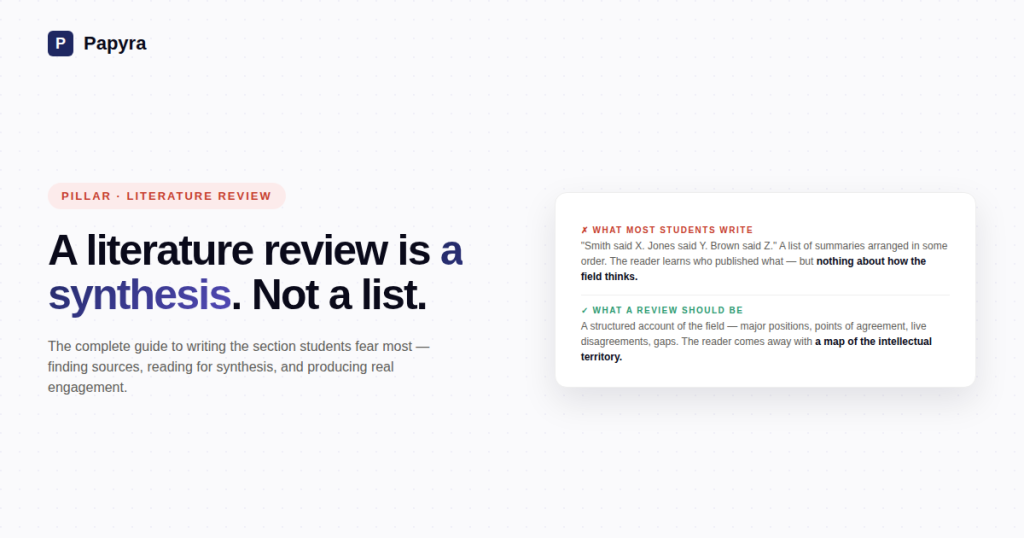
A bad literature review is a list. The student finds ten papers on a topic, summarizes each one in a paragraph, and arranges the paragraphs in some order — chronological, alphabetical, by importance. The structure is essentially: Smith said X, Jones said Y, Brown said Z. The reader finishes with a vague sense of what has been written about the topic but no understanding of how the field thinks, what the field disagrees about, or what is at stake.
A good literature review is a synthesis. It does not just describe what others have written. It assembles their work into a structured account of the field — the major positions, the points of agreement, the live disagreements, the gaps that have not been adequately addressed. A reader of a good review comes away with a map of the intellectual territory, including landmarks and contested borders.
The difference matters because the literature review is doing specific intellectual work in your paper. It is establishing what is already known so that your contribution can be located. It is building the platform that supports your argument. A list of summaries does not do this work. A synthesis does.
This article is the complete process: how to find sources, how to read them in a way that makes synthesis possible, how to organize what you find, and how to write the review that actually demonstrates the engagement your professor is looking for.
—
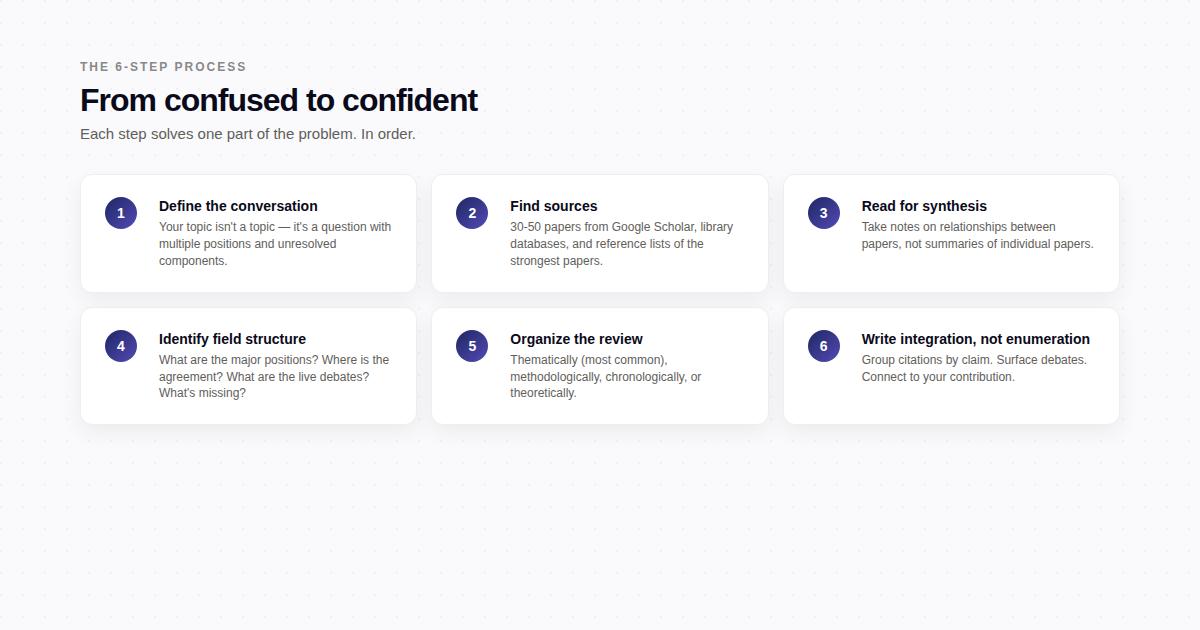
Step 1: Define the conversation
Before you search for a single paper, define the conversation you are joining. This is the step almost every undergraduate skips and almost every graduate student treats as the foundation.
The literature review is not about a topic. It is about a question within a topic. “Climate change” is not a literature review. “What policy mechanisms have been most effective at reducing emissions in mid-sized European economies between 2010 and 2020” is a literature review. The first is a domain. The second is a question that has answers, partial answers, contested answers, and unanswered components — which is the structure a literature review needs to map.
A useful framing question has three properties:
Specific enough to search for. “What policies have reduced emissions” is too broad — millions of papers discuss this. “What carbon pricing mechanisms have been most effective in mid-sized European economies between 2010 and 2020” narrows the literature to a manageable corpus, perhaps a few hundred papers.
Open enough to have multiple positions. “Did the EU adopt the ETS in 2005” is too narrow — it has one factual answer. A good literature review question has competing perspectives in the existing scholarship.
Connected to your eventual argument. The point of the review is to establish the context for your contribution. The framing question should be the question your paper goes on to address.
Spend time on this step. A poorly framed question produces a literature review that wanders. A well-framed question makes the rest of the process structured rather than open-ended.
—
Step 2: Find the sources
With the question defined, source-finding becomes a directed activity rather than an open search.
The hierarchy of source quality, for academic literature reviews:
Peer-reviewed journal articles are the gold standard. Articles published in established journals have been evaluated by anonymous experts before publication. They use established methodologies, cite their evidence specifically, and engage with prior work in their fields. Most literature reviews should consist primarily of these.
Edited volumes from academic publishers (Cambridge University Press, Oxford, Routledge, MIT Press, university presses generally) are the next tier. Chapters in edited volumes have been peer-reviewed; the editorial filter is rigorous.
Books from academic publishers are slightly lower in priority because individual book chapters are not always cited as units in literature reviews, but landmark monographs in a field are essential context.
Working papers and conference proceedings are useful for very recent work that has not yet appeared in journal form. Treat them as preliminary — citations to working papers should be checked against any subsequent journal publication.
Government reports, policy documents, and institutional white papers are appropriate when the topic involves policy or institutional analysis. They do not replace peer-reviewed scholarship but supplement it.
Popular press articles are almost never appropriate for the body of a literature review, though they may appear in the introduction to motivate the topic.
The platforms to find sources, in order of utility:
Google Scholar for breadth. Search your question, scan the results, identify the most-cited papers, follow the citation tree backward (what did this paper cite?) and forward (what cited this paper?).
Web of Science and Scopus for systematic coverage. These databases index peer-reviewed publications more rigorously than Google Scholar and let you filter by journal quality, citation count, and date range.
Your university library’s database for access. Most peer-reviewed papers are paywalled. Your library’s subscription gives you the actual full text, which you will need.
The reference lists of the strongest papers you find. This is the most underused source-finding technique. When you locate a strong paper on your question, its reference list is a curated guide to the prior literature on the question. The first 20 papers you find through Google Scholar may take an hour. The next 20, mined from reference lists of the first batch, take 15 minutes and are usually higher quality.
Verified sources matter more than discovered sources. Papyra’s academic writing tool generates literature reviews with citations sourced from CrossRef, OpenAlex, and Semantic Scholar — every reference is real, every DOI resolves, every author is verifiable. The kind of bibliography that anchors a real literature review.
—
Step 3: Read for synthesis, not summary
The reading phase is where most undergraduate literature reviews go wrong.
The undergraduate default is to read each paper, write a paragraph summarizing what it said, and move on. After reading 20 papers, the student has 20 paragraphs of summary and faces the harder task of organizing them. Inevitably the organization becomes a list, because the readings were performed as discrete summaries rather than as moves in an ongoing intellectual conversation.
The reading method that produces synthesis is structurally different. For each paper, you take notes not on what the paper says, but on how the paper relates to other papers you have read. Specifically:
What is the paper’s central claim? One sentence. The thesis the paper is making.
Who or what does this paper agree with? Note the citations. Which other papers in your corpus does this one build on? Whose conclusions does it accept?
Who or what does this paper disagree with? Note the contested citations. Which prior arguments does it challenge? Where does it identify gaps in earlier work?
What does this paper add? Where does it fit in the conversation? Is it a methodological contribution, an empirical contribution, a theoretical contribution, a synthesis of prior work?
After 20 papers read this way, you have not 20 isolated summaries. You have a structured map of the field — which papers are foundational, which form the major opposed positions, which represent live debates, which methodologies are dominant. The organization of the literature review writes itself from this map.
The note-taking format matters less than the structure of attention. A spreadsheet works. A notebook works. The matrix method — popularized by Judith Garrard’s Health Sciences Literature Review Made Easy — uses a table where rows are papers and columns are dimensions (claim, methodology, sample, finding, position on debate). Adapt the format to your topic.
—
Step 4: Identify the structure of the field
After 20-30 papers, you should be able to articulate the structure of the conversation in your topic. This is the intellectual core of the literature review.
What does structure look like? Consider an example: a literature review on the question of AI detection accuracy in academic writing.
After reading the relevant papers, the structure might emerge as:
– Foundational position: Detection tools claim near-perfect accuracy on the basis of their own internal benchmarking (Turnitin technical papers, GPTZero documentation, Originality.AI accuracy reports).
– The first major challenge: Liang et al. (2023) demonstrated systematic bias against non-native English speakers, with 61% false positive rates (DOI: 10.1016/j.patter.2023.100779).
– Industry response: Several detector companies challenged the methodology of the Stanford study and presented their own data showing lower bias on their specific tools.
– The second major challenge: Studies on neurodivergent writers (autism, ADHD, dyslexia) showed similar elevated false positive rates, suggesting the bias is structural to perplexity-based detection.
– Institutional response: Vanderbilt, Johns Hopkins, and others disabled detection tools in 2023-2024.
– Live debates: Whether next-generation detectors using different architectures can avoid these biases. Whether detection is sustainable as a strategy at all. What replaces it pedagogically.
– Gap: Most existing work has focused on Western institutions; non-Western higher education contexts are under-studied.
This structure is what the literature review needs to communicate. Notice that it is not chronological — it follows the logical structure of the debate, not the temporal order of publications. A reader of this review comes away with a map of the field, not a list of summaries.
—
Step 5: Organize the review
Now write the review using the structure you identified. The most common organizational patterns for literature reviews:
Thematic. Group sources by topic, position, or sub-question. This is the most common pattern in social science and humanities reviews. Each section addresses one component of the field’s structure.
Methodological. Group sources by research approach — quantitative versus qualitative, experimental versus observational, theoretical versus empirical. This works well for fields where methodological debates are prominent.
Chronological. Trace the development of thinking on a question over time. This is appropriate when the topic has a clear historical arc and the field’s thinking has evolved meaningfully.
Theoretical. Group sources by the theoretical framework they employ. Useful in fields where competing theoretical traditions structure the conversation.
For most undergraduate and master’s-level reviews, the thematic organization is the default. It produces a review that engages with the substance of the field rather than the surface chronology of publications.
Within each section, the writing pattern is integration, not enumeration. Instead of:
“Smith (2020) found X. Jones (2021) found Y. Brown (2022) found Z.”
You write:
“The dominant finding across studies in this period is that X holds under conditions A and B (Smith, 2020; Jones, 2021), though Brown (2022) identified a counterexample in setting C that has not been fully reconciled with the broader pattern.”
The second version groups citations by claim, identifies the dominant pattern, and surfaces the live debate. It is what synthesis looks like in prose.
—
Step 6: Write the review
The actual prose of the literature review has a recognizable structure across disciplines.
Introduction. Frame the question, indicate the scope of the review (which sub-literatures are covered, which are excluded), preview the structure. A good literature review introduction is two to four paragraphs, not pages.
Body sections. Organized thematically (or methodologically, or chronologically) according to the structure of the field. Each section addresses one component of the conversation, integrates the relevant sources, and surfaces the live debates and gaps within that component.
Synthesis section. The most important and most-skipped part. After mapping the field, the synthesis section explains what the overall pattern means — where the field has converged, what it disagrees about, where the gaps are. This is the section that demonstrates real engagement rather than mere coverage.
Connection to your contribution. The final move is to position your own paper relative to the literature you have just reviewed. Which gap will you address? Which debate will you contribute to? The literature review does not just exist for its own sake — it builds the platform for your argument.
In an undergraduate paper, the entire review might be 2,000-4,000 words. In a master’s thesis, 8,000-15,000. In a PhD dissertation, 20,000+. The principles are the same; the depth scales.
—
What good and bad reviews look like, side by side
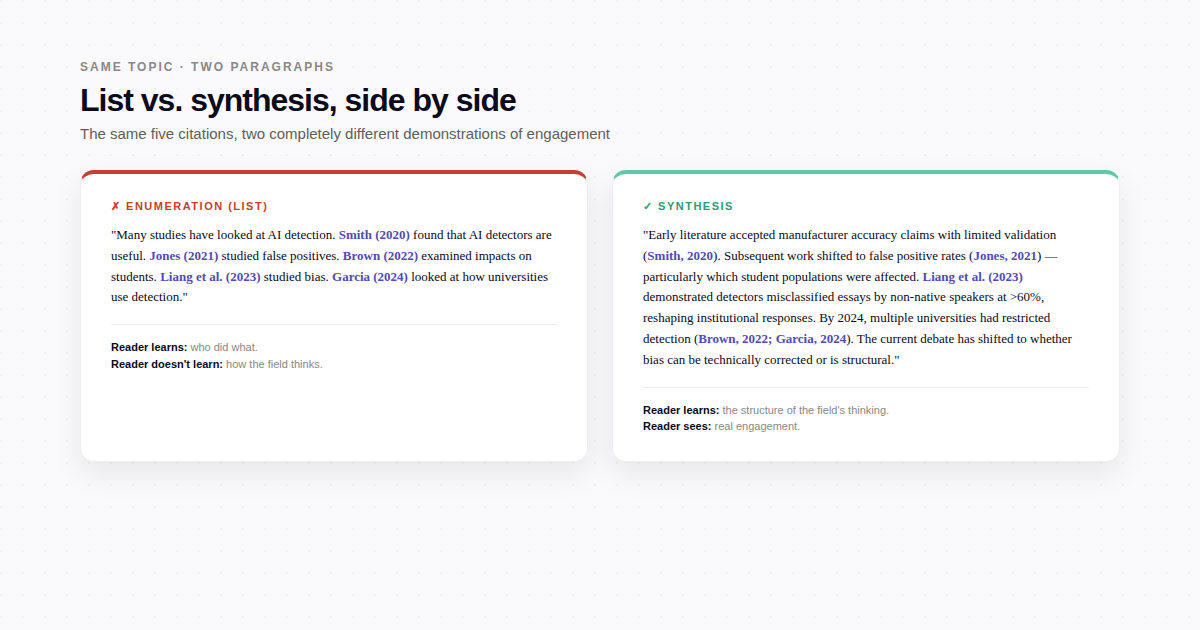
Consider two versions of a single paragraph in a literature review on AI detection.
The bad version (enumeration):
“Many studies have looked at AI detection. Smith (2020) found that AI detectors are useful for identifying machine-generated text. Jones (2021) studied false positives in AI detection. Brown (2022) examined the impact of AI detection on students. Liang et al. (2023) studied bias in AI detection tools. Garcia (2024) looked at how universities use AI detection.”
This is summary as list. The reader learns who did what, but not how the field thinks.
The good version (synthesis):
“The early literature on AI detection accepted manufacturer claims of high accuracy with relatively limited independent validation (Smith, 2020). Subsequent work shifted attention to false positive rates (Jones, 2021), particularly the question of which student populations were affected. Liang et al. (2023) demonstrated that seven major detection tools misclassified essays by non-native English speakers at rates exceeding 60% — a finding that reshaped institutional responses. By 2024, multiple universities had disabled or restricted detection tools, citing the disparate impact on already-marginalized student populations (Brown, 2022; Garcia, 2024). The current debate has shifted from whether detection is biased to whether the bias can be technically corrected or is structural to the underlying methodology.”
The second version organizes the citations around the actual development of the field’s thinking. A reader comes away understanding what happened intellectually, not just what was published when.
—
Common mistakes to avoid
Recency bias. The most recent papers are not necessarily the most important. A 2018 paper that is cited 2,000 times is more central to the field than a 2024 paper cited 12 times. Cite according to the structure of the field, not the calendar.
Citation laundering. Citing a paper based on what another paper said about it, without reading the original. This produces compounded errors and is often visible in the resulting writing — the citations do not quite match what the cited papers actually say.
Unbalanced coverage. A literature review that engages deeply with one position and dismisses others is advocacy, not review. The point of a review is to map the field, including the parts you disagree with.
Excessive caveat. Some students compensate for thin engagement by adding methodological qualifications to every claim. “Smith (2020) found, in a study with limitations on sample size and external validity, that…” This pattern signals nervousness rather than rigor. State findings clearly; reserve qualification for places where the qualification actually matters.
Hallucinated citations. The most damaging mistake is citing sources that do not exist. AI tools that generate citation lists frequently invent papers, with confident-looking author names, plausible journal titles, and DOIs that do not resolve. A literature review with hallucinated citations is the kind of academic disaster that ends careers. Verify every citation before submission, ideally using a tool that retrieves real records from CrossRef or OpenAlex rather than generating plausible-looking fakes.
—
A practical workflow
For an undergraduate literature review (2,000-4,000 words), the realistic workflow is:
Days 1-2: Define the question. Read three or four landmark papers in the field to establish the conversation.
Days 3-7: Source discovery. Find 30-50 papers across Google Scholar, your library database, and reference lists.
Days 8-14: Reading with structured notes. Map the field as you go. Stop when you have a clear picture of the conversation, usually around 25-35 papers.
Days 15-16: Outline. Identify the structure. Decide on thematic organization.
Days 17-21: Draft. Write each section. Integrate citations rather than listing them.
Days 22-23: Revise. Remove enumeration patterns. Strengthen synthesis sections.
Day 24: Verify all citations against the original sources. Confirm DOIs resolve. Confirm authors and journal titles match.
For a master’s thesis literature review, multiply each phase by three to four. For a PhD, by ten. The workflow is the same.
—
The deeper point
Writing a good literature review is one of the most transferable skills in academic work. It is, fundamentally, the skill of building an intellectual map of a contested terrain — identifying the major positions, the points of agreement, the live disagreements, the gaps in current understanding.
This skill is what separates students who can produce publishable academic work from students who can only summarize. It is what professors are evaluating when they read your literature review. They are not testing whether you read the right papers. They are testing whether you can think about a field, not just within it.
The good news is that this skill is learnable through practice. The first literature review most students write is largely list. The second is somewhat better. By the third, with deliberate attention to synthesis, students are producing reviews that demonstrate real engagement with their field.
The five-step method above is the structure that accelerates this learning. It is not a substitute for reading carefully and thinking clearly. But it is the scaffold that makes those harder cognitive moves more likely to succeed.
—
Want a literature review with citations you can actually defend?
Papyra writes literature reviews with sources retrieved from CrossRef, OpenAlex, and Semantic Scholar — every reference is real, every DOI works, every author is verifiable. The kind of bibliography that holds up to any scrutiny, in any reading, by any examiner.
