
The detection software you have heard of is the smaller half of the story
When students ask “how do professors detect AI writing,” they usually mean: which detection tool is the professor using? The assumption is that there is some piece of software that ingests submissions, produces a percentage, and triggers an investigation when the percentage is high.
That happens. Turnitin, GPTZero, Originality.AI, and ZeroGPT all sell to universities, and large institutions have purchased licenses. But it is the smaller half of the story.
The bigger half — the methods experienced professors actually rely on — is human judgment, often supplemented by simple comparisons with prior student work, and increasingly enforced through assignment redesign rather than detection. A 2024 survey of 1,000 university faculty by Tyton Partners, an education research firm, found that only about 35% of professors used dedicated AI detection tools regularly. The remaining 65% relied on a combination of personal judgment, oral defense, draft review, and assignment design changes that make AI assistance harder to use undetected.
This article describes how detection actually works, in the order professors typically apply methods.
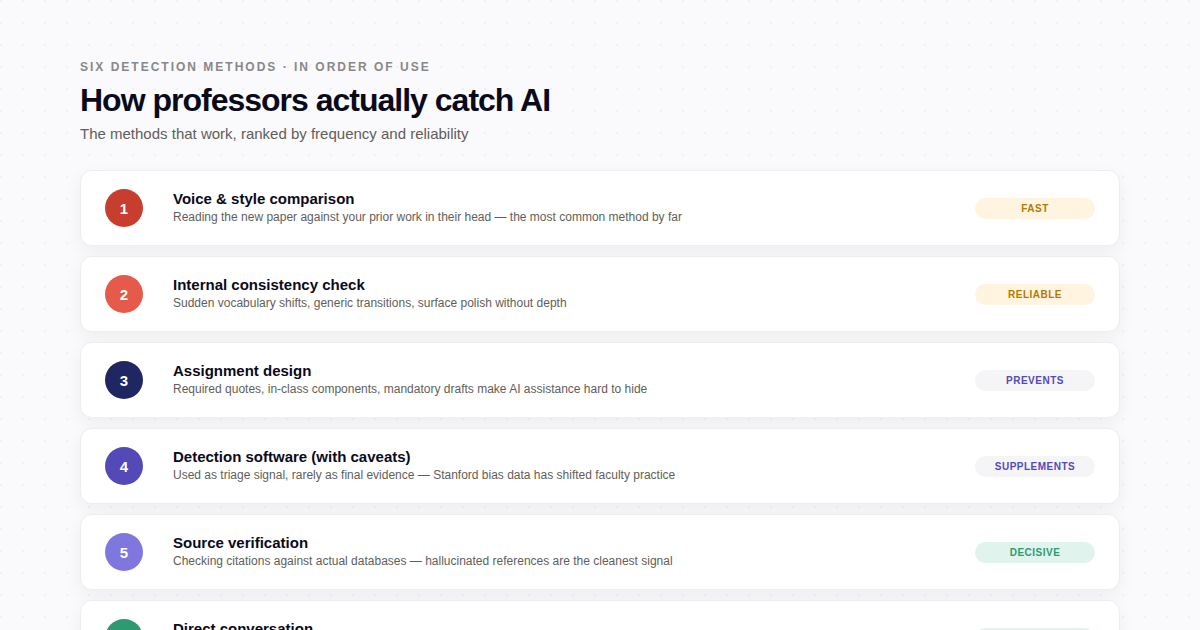
Method 1: Style and voice comparison against prior work
The single most common detection method is also the simplest: the professor reads your submission and compares it, mentally, against the previous work you have submitted in the same course.
Most students have a writing voice. They use specific phrasings repeatedly, they construct arguments in characteristic ways, they make the same kinds of grammatical errors, they have a vocabulary range that does not change radically between assignments. When a professor receives a paper that does not match this established baseline — sentences are suddenly more polished, vocabulary suddenly more sophisticated, transitions suddenly more elegant — the question forms automatically.
This works without any software. It works because humans are pattern-detection machines, and a professor reading their fortieth paper of the term has internalized your voice whether they intended to or not.
The implications are practical. Submitting one polished AI-assisted paper into a course where your earlier work was rough is the equivalent of waving a flag. The discrepancy is what triggers attention. Consistent quality across submissions, even if individual submissions are imperfect, attracts no notice.
Method 2: Internal consistency checks within a single paper
The next layer is internal. Even within a single paper, AI-assisted work often has structural inconsistencies that experienced readers notice.
Common patterns:
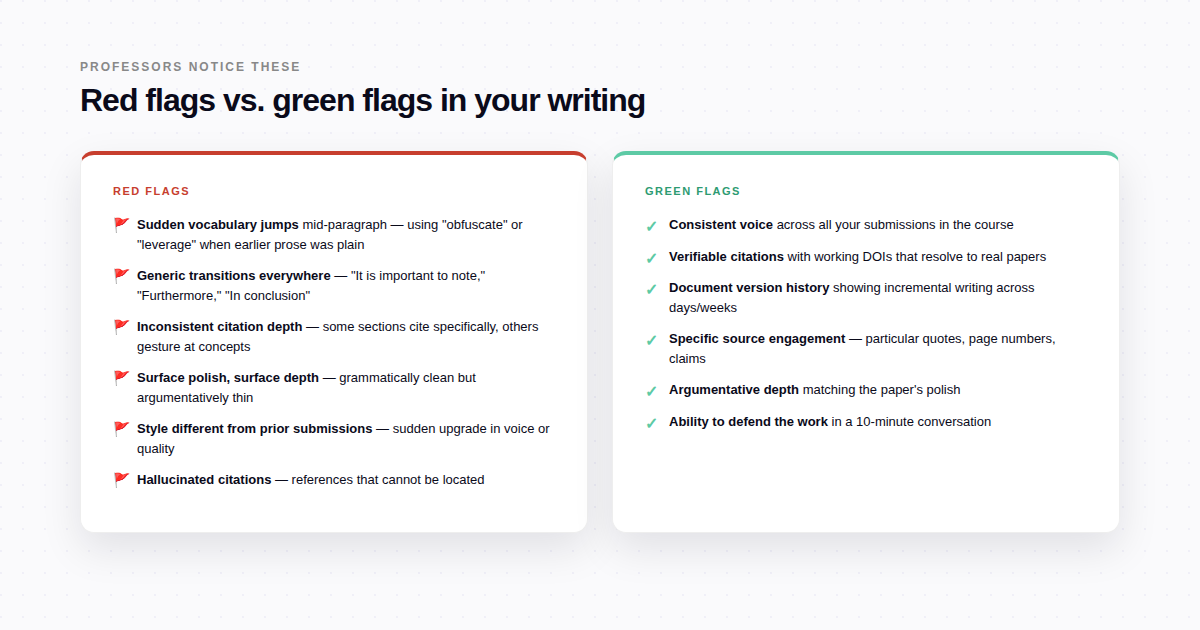
Sudden vocabulary shifts within paragraphs. A student writes a paragraph in plain prose, then a sentence appears using “obfuscate,” “leverage,” and “paradigm” — words that did not appear earlier in the paper. Professors notice this.
Generic transitions in unexpected places. AI tools love phrases like “It is important to note,” “Furthermore,” “In conclusion,” “This essay will explore.” A paper sprinkled with these in a student voice that previously used simpler connectives stands out.
Inconsistent levels of citation. Sections of the paper that demonstrate deep engagement with sources, alongside sections that gesture at concepts without specific support. A paper where some paragraphs cite real, properly-formatted sources and others assert claims with no citation at all is a flag.
Surface polish, surface depth. AI-assisted writing tends to be grammatically clean but argumentatively thin. Professors who specialize in their field can spot when a paper is making the standard moves of the genre without the underlying engagement that produces those moves organically.
Defensible academic work needs verifiable evidence. Papyra’s academic writing tool generates papers with citations matched to real sources via CrossRef and OpenAlex — the kind of paper trail where every reference resolves and every claim is supported by a real, locatable source.
Method 3: Assignment design that makes AI assistance harder
Some of the most effective detection is preventative. A growing number of professors design assignments specifically to make AI assistance difficult to use undetected.
Examples that have been documented in the higher-education literature:
Annotated bibliographies with required quotes. The student must include three direct quotations from each source, with page numbers. AI tools that hallucinate sources cannot produce real page numbers from real books, because the page numbers do not correspond to the fictional sources.
Reflection-on-process essays. A required component asks the student to describe their writing process — the moments of difficulty, the decisions made about structure, the specific source that changed their argument. These are hard to fabricate convincingly.
In-class component. A take-home essay is followed by a 15-minute oral conversation in office hours where the student is asked to explain three claims from the paper. AI-assisted work falls apart under this format because the student cannot defend the synthesis they did not perform.
Iteration with mandatory drafts. The assignment requires the student to submit drafts at intervals, with the final paper graded as the cumulative product. A paper that materializes fully formed at the deadline, with no draft history, is a signal.
These designs do not catch AI use after the fact. They create conditions under which AI use either does not work or becomes obvious during the process.
Method 4: Detection software (with caveats)
When professors do use detection software, they typically use it as one input among several, not as a final verdict. The 2024 Tyton Partners survey found that among professors who used detectors, fewer than 30% considered detector output sufficient evidence to file an academic integrity case on its own.
The reasons are well-documented. The Stanford study by Liang et al. (2023) showed AI detectors misclassifying 61% of essays by non-native English speakers. Vanderbilt University publicly disabled Turnitin’s AI detector in August 2023, citing the calculated risk of falsely flagging hundreds of innocent students. Johns Hopkins followed. The University of Michigan’s Center for Research on Learning and Teaching now formally advises faculty against using AI detection scores as sole evidence of misconduct.
Professors who continue to use detection tools tend to use them in two ways: as a triage signal that prompts closer reading, or as supporting evidence alongside other indicators. Almost no responsible faculty member treats a high AI detection score, by itself, as proof.
Method 5: Source verification
This is the method most students underestimate. When a professor suspects a paper might be AI-assisted, the fastest verification is checking the bibliography.
The professor picks one or two citations and tries to locate them. If the citations resolve to real papers that contain content supporting the cited claim, the paper is almost certainly authentic. If the citations cannot be found — because the papers do not exist, or the cited claim does not appear in the paper, or the journal does not publish work in that field — the case is essentially proven.
Hallucinated citations are the most reliable signal of AI generation, because no human researcher invents fake sources. A student who does their own work cites real papers. A student who has AI generate a paper for them often ends up with at least one fake reference, because general-purpose chatbots invent citations confidently. The case of Mata v. Avianca — the lawyer fined $5,000 in 2023 for submitting a brief with six fake citations generated by ChatGPT — established the pattern in legal practice. The same pattern applies in academic work.
The only reliable way to avoid this signal is to ensure every citation in your paper is real and verifiable. Tools designed specifically for academic work, including Papyra’s citation engine, retrieve verified records from CrossRef and OpenAlex before any reference is added to a draft. The output is a bibliography that always passes source verification.
Method 6: Direct conversation
The final method, and arguably the most reliable, is asking the student to defend their work.
A professor who suspects AI assistance can request a 10-minute conversation about the paper. The questions are usually simple: explain your argument in your own words; what was the most difficult part to write; which source most influenced your thinking; what would you change if you rewrote this; what counter-argument did you consider and reject.
A student who wrote the paper can answer all of these. A student who outsourced the writing usually cannot answer most. The conversation does not require any special expertise from the professor — they are not testing the student’s knowledge, they are testing whether the student has the kind of relationship with their own paper that authentic authorship produces.
This method is so reliable that some institutions are formalizing it. The University of British Columbia and several Australian universities now permit faculty to require oral defense of any submitted work, with the defense itself counting as part of the grade. The mere existence of the option is enough to deter most outsourced submissions.
What this means for students
The implications, for students who want to do their own work but use AI ethically as a tool:
Maintain a consistent voice. Do not submit one paper that reads like Hemingway and a follow-up that reads like a graduate seminar transcript. If AI assists you, calibrate the assistance to match your established voice rather than upgrading it.
Keep your sources real. Verify every citation. The single fastest way to fail the source verification test is to use a general-purpose chatbot that hallucinates references. Use academic databases, library catalogs, or tools specifically designed to retrieve verified citations.
Document your process. Drafts, notes, source PDFs, version history. The student who can produce these on demand is unfailing in any conversation about authorship.
Be ready to discuss your work. If you wrote the paper, you can talk about it. The defense is the easiest part. If you cannot defend the work, the work was not yours, and that fact will surface eventually.
The detection arms race will continue. Detection tools will get better and worse. Universities will swing between aggressive and lenient enforcement. The constant, across all of it, is that students who do their own work and document the process are essentially uncatchable, because there is nothing to catch.
—
Want academic work that holds up to any verification check?
Papyra generates papers with citations sourced from CrossRef, OpenAlex, and Semantic Scholar — every reference resolves, every author exists, every DOI works. The kind of paper trail that makes source verification a non-event.
