The number Turnitin doesn’t lead with
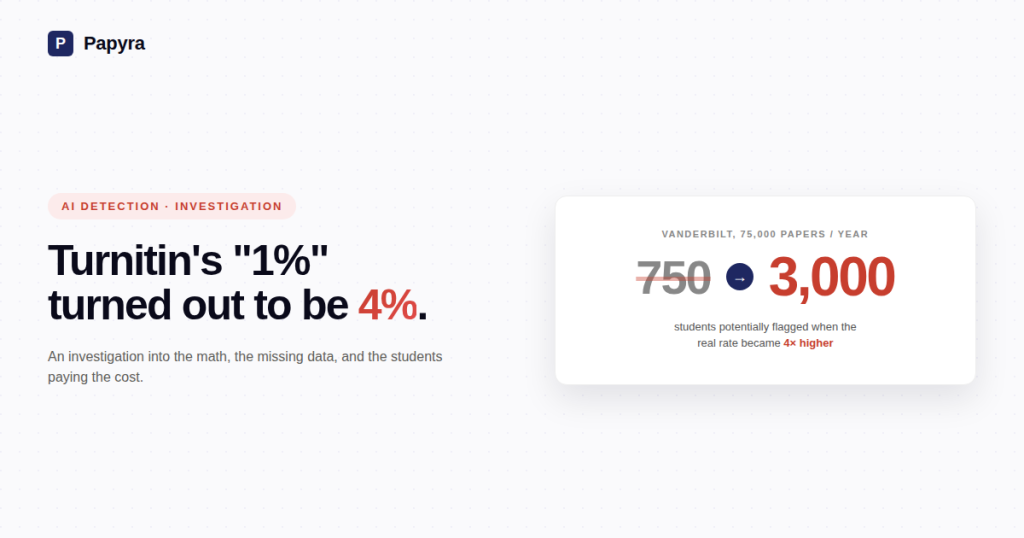
When Turnitin launched its AI writing detector in April 2023, the company put a single statistic at the center of its marketing: a false positive rate of less than 1%.
It is a number that sounds reassuring. Less than one in a hundred. The kind of margin a careful person can live with.
Three months later, Turnitin’s chief product officer Annie Chechitelli quietly published a follow-up. The 1% figure, she clarified, applied only to documents — and only to documents the system had already classified as containing more than 20% AI-generated text. At the level of individual sentences, the rate the company was now willing to acknowledge was different.
It was 4%.
That distinction matters more than it sounds. And once you do the math, it stops sounding reassuring at all.
Vanderbilt did the math
In August 2023, Vanderbilt University became the most prominent institution to disable Turnitin’s AI detector entirely. Their reasoning, published in a public statement from the Brightspace team, was unusually direct.
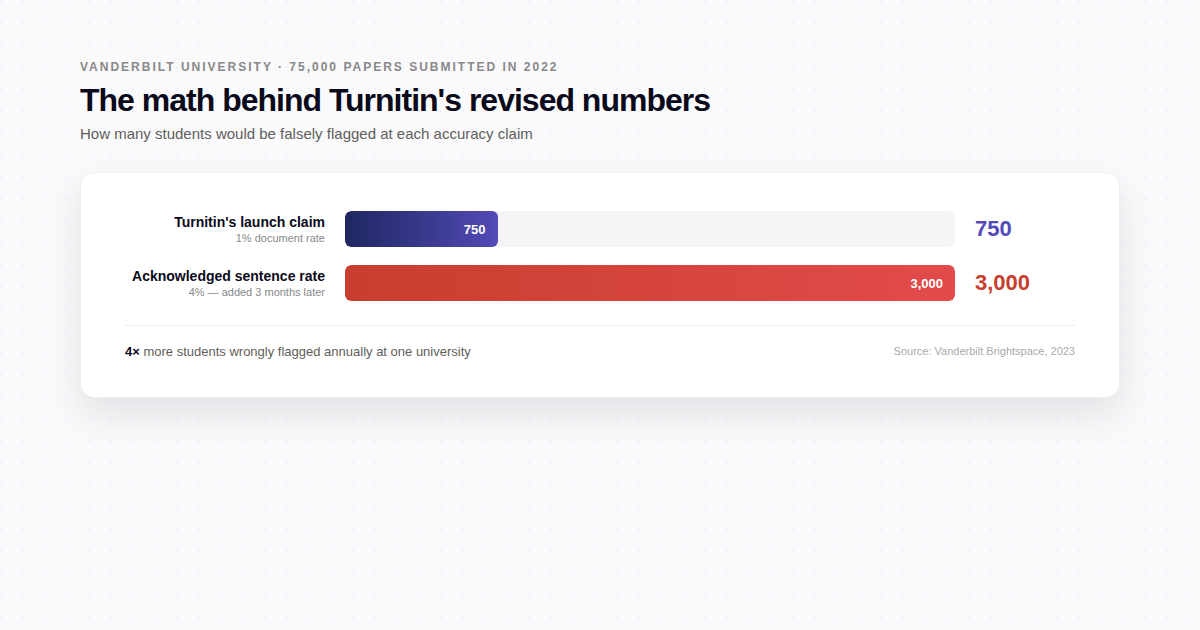
Vanderbilt had submitted roughly 75,000 student papers to Turnitin in 2022. At the original 1% false positive rate, that would have meant approximately 750 students each year flagged for AI-generated writing they did not actually produce.
After Turnitin’s revised numbers, Vanderbilt updated the calculation. At the 4% sentence-level rate, the number rose to around 3,000 papers — about one in twenty-five.
The university’s conclusion was stark: “Use of the detection tool at this time is simply not supported by the data and does not represent a teaching practice that we can endorse or support.”
Vanderbilt is not a fringe institution making a fringe argument. Johns Hopkins disabled AI detection over the same accuracy concerns. Carnegie Mellon publicly noted that no AI detector currently on the market has been “established as accurate.” The University of Pittsburgh’s Teaching Center reached a similar conclusion after its own internal review.
The bibliography you submit is the bibliography you’ll have to defend. Papyra’s Document Correction tool reads your professor’s feedback and adds verified, traceable sources — every citation matched to a real paper with a working DOI. The kind of evidence that resolves these conversations in your favor.
How a “less than 1%” rate becomes a problem
There is a temptation to look at a 1% or 4% error rate and assume it averages out — that it produces a manageable number of edge cases sprinkled across millions of submissions.
The math does not work that way.
Consider the scale at which Turnitin operates. The company processes hundreds of millions of submissions a year across thousands of institutions. A 1% rate at that scale is not an edge case. It is millions of papers. A 4% sentence-level rate, applied across the same volume, produces a number that no academic integrity office in the world is set up to handle case by case.
It also does not distribute evenly. Which is the part of the conversation Turnitin’s marketing has consistently avoided.
The students who get flagged most
Multiple peer-reviewed studies have now demonstrated the same finding: AI detectors produce dramatically higher false positive rates for specific groups of students.
The 2023 Stanford study by James Zou and colleagues remains the most-cited. Across seven of the leading AI detection tools, essays written by non-native English speakers were misclassified as AI-generated in 61% of cases. Essays written by native English speakers, scored by the same detectors, were misclassified at a rate close to zero.
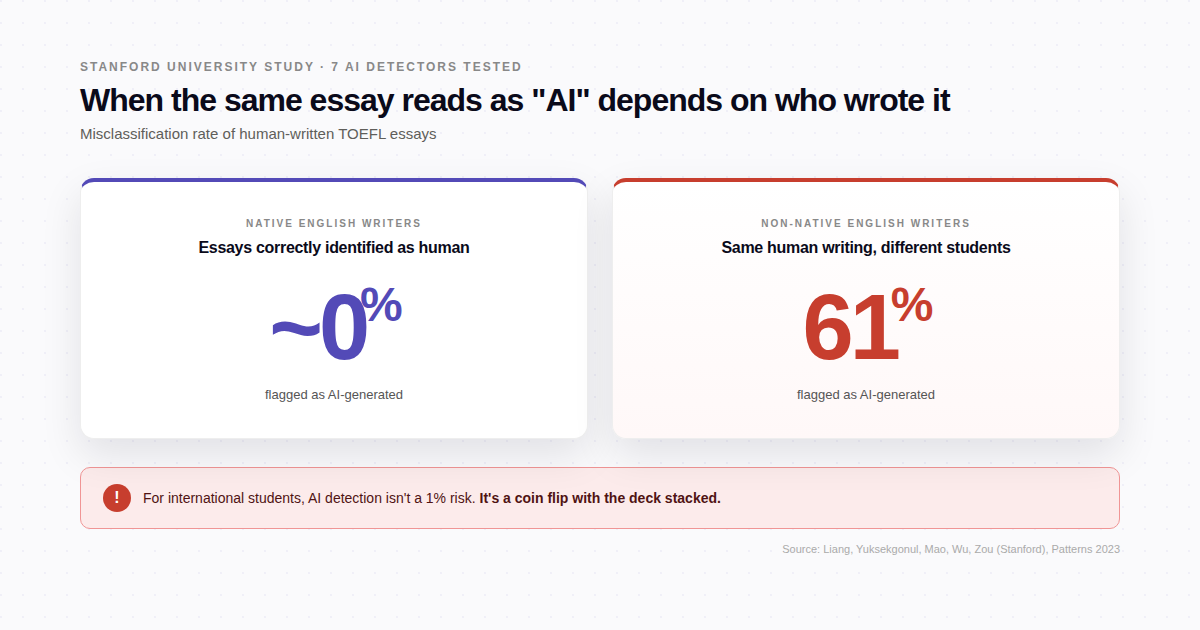
Sixty-one percent. Not a rounding error. Not a tail risk. A coin-flip with the deck stacked against you.
The pattern repeats with neurodivergent students. Research published since has documented elevated false positive rates for students with autism, ADHD, and dyslexia — groups whose writing tends to feature the kind of repetitive phrasing, structural regularity, and limited vocabulary range that AI detectors interpret as machine-generated. A Purdue professor named Rua Mae Williams was personally flagged by an AI detector while submitting their own academic writing. Williams is autistic.
For these students, the published 1% rate is fiction. The lived rate is much, much higher. And the consequences — academic integrity hearings, failed courses, suspended degrees, denied visas for international students — fall on them disproportionately.
What Turnitin will and will not say
To Turnitin’s credit, the company has not entirely hidden from these findings. Chechitelli’s blog posts have acknowledged that the sentence-level rate is higher than the document rate. The company has added asterisks to results below the 20% threshold, calling them “less reliable.” It has published guidance for instructors warning them not to treat AI detection scores as proof of misconduct.
What Turnitin has not done is publish a full breakdown of accuracy by student demographic. It has not released its training data for independent audit. It has not allowed third-party researchers — Stanford’s Soheil Feizi has asked, repeatedly — to test the system at scale on real student writing.
In a 2023 interview with the Washington Post, Feizi proposed a benchmark: a 0.01% false positive rate, the threshold he considers minimally acceptable for a tool that can derail a student’s academic career.
His own assessment of whether current detectors can reach that benchmark: “At this point, it’s impossible.”
What students can actually do
If you are a student worried about being falsely flagged — and the data suggests that worry is rational, particularly if English is not your first language — there are practical steps that protect you.
Keep your version history. Google Docs, Microsoft 365, and most modern writing tools log edits automatically. A document with hundreds of small revisions over weeks is hard to mistake for AI output. Make sure that history is enabled and exportable before you submit anything important.
Save your sources. Every paper you cite should be one you have actually read, with a verifiable DOI or URL you can produce on request. AI tools that invent fake citations — and most general-purpose chatbots do — leave students with bibliography entries they cannot defend. A real, verifiable source list is the strongest possible evidence that the work is yours.
Document your process. Notes, outlines, abandoned drafts, even the messy first version of an introduction you later rewrote — keep them. They are the kind of evidence that resolves an academic integrity meeting in your favor in under five minutes.
Know the policy. Your institution’s academic integrity procedure is almost certainly online. Read it before you need it. Most policies require human judgment, not algorithmic flags, before any sanction can be imposed. That distinction has saved a lot of students.
The broader picture
The story of Turnitin’s false positive rate is not really a story about Turnitin. It is a story about a category of technology that has been deployed at massive scale before its accuracy could be independently verified — and about the students, especially international students and those with learning differences, who are paying the cost of that deployment.
Universities are starting to recognize this. The list of institutions that have disabled or restricted AI detection now includes Vanderbilt, Johns Hopkins, the University of Pittsburgh, the University of British Columbia, and a growing number of others. More will follow.
In the meantime, the most useful thing a student can do is to write in a way that produces evidence — sources you can verify, version history you can show, a process you can describe. The detectors will keep being wrong. The students who can defend their work will be fine.
—
Want a bibliography that defends itself?
Papyra writes academic essays where every citation is traced to a real, published paper — verified through CrossRef, OpenAlex, and Semantic Scholar before it touches your draft. No invented authors. No fabricated DOIs. No hallucinated journal names.
The kind of bibliography that ends an academic integrity meeting in five minutes.
