Why citation feels harder than it should
Most students do not struggle with APA format because the rules are inherently complex. They struggle because they encounter the rules in fragmentary form — a partial guide for journal articles, a different guide for books, a separate guide for online sources, a confusing addendum about authors with the same surname. By the time you finish a paper, you have looked up the same rule three times in three different places.
This article reorganizes the work. It covers the four rules that handle the overwhelming majority of citations, the edge cases that come up in practice, and a verification step that most students skip and that solves most of the remaining headaches.
The current standard is APA 7th edition, published in October 2019, which is what virtually every institution requires in 2026 unless explicitly stated otherwise.
The four rules
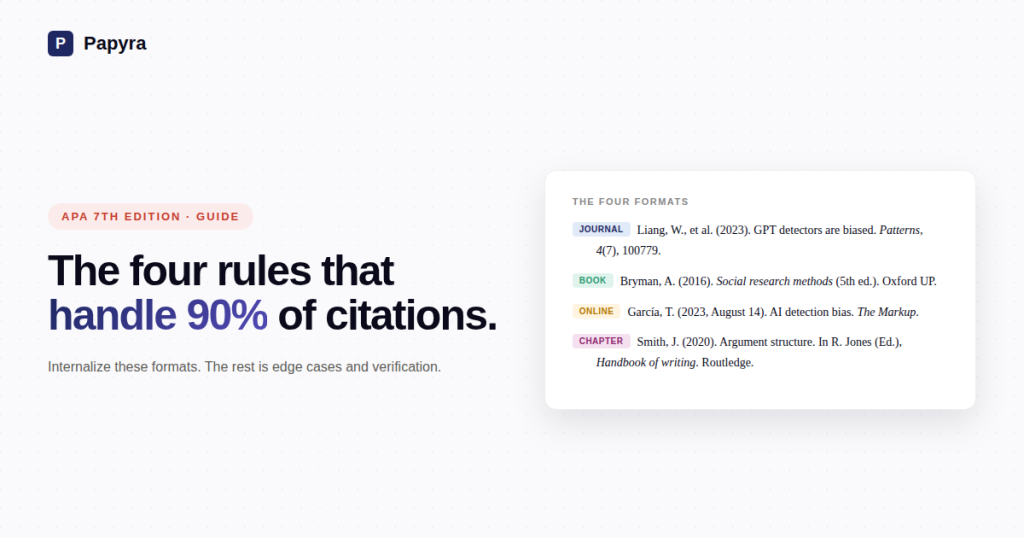
Most papers cite four kinds of sources: journal articles, books, online sources, and chapters in edited books. Roughly 90% of academic citations fall into one of these categories. If you internalize the format for each, you can write most of your bibliography from memory.
Rule 1: Journal articles
Author, A. A., & Author, B. B. (Year). Title of article. Journal Name, Volume(Issue), Page–Page. https://doi.org/xxxxx
A real example:
Liang, W., Yuksekgonul, M., Mao, Y., Wu, E., & Zou, J. (2023). GPT detectors are biased against non-native English writers. Patterns, 4(7), 100779. https://doi.org/10.1016/j.patter.2023.100779
The five elements are: authors with comma-separated initials, year in parentheses, article title in plain text, journal name and volume in italics with issue in parentheses, page range, and DOI as a hyperlink. Every modern journal article should have a DOI; if it doesn’t, the source is probably old enough to live without one.
Rule 2: Books
Author, A. A. (Year). Title of book. Publisher.
Example:
Bryman, A. (2016). Social research methods (5th ed.). Oxford University Press.
The italicized title goes in sentence case (capitalize the first word and proper nouns only). Edition number, when relevant, follows in parentheses after the title. Publisher city is no longer required in APA 7.
Rule 3: Online sources
Author, A. A. (Year, Month Day). Title of article. Site Name. URL
Example:
García Mathewson, T. (2023, August 14). AI detection tools falsely accuse international students of cheating. The Markup. https://themarkup.org/machine-learning/2023/08/14/ai-detection-tools-falsely-accuse-international-students-of-cheating
The full date is required when available. Site name is italicized. Use the original URL — do not substitute a shortened version.
Rule 4: Chapter in an edited book
Author, A. A. (Year). Title of chapter. In E. Editor (Ed.), Title of book (pp. xx–xx). Publisher.
Example:
Smith, J. (2020). The structure of academic argument. In R. Jones (Ed.), Handbook of writing in higher education (pp. 45–62). Routledge.
Real citations resolve. Hallucinated ones don’t. Papyra’s academic writing tool generates papers where every reference is matched to a real, published source through CrossRef and OpenAlex — every DOI resolves, every author exists, every journal is real.
In-text citations: the parenthetical rules
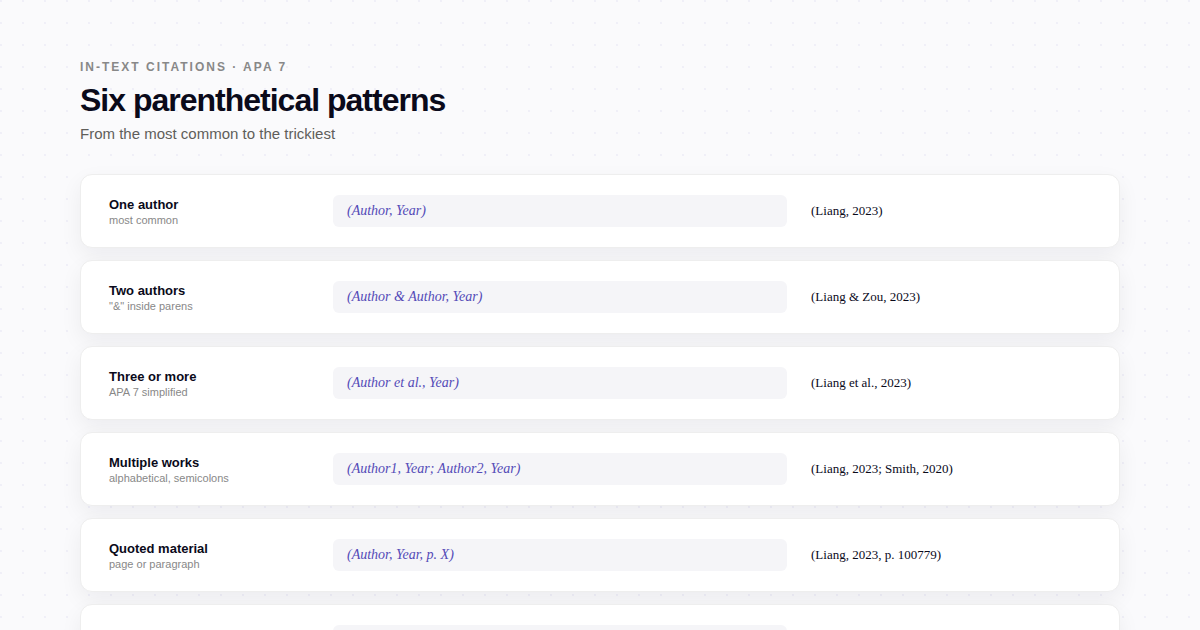
In-text citation in APA is a parenthetical reference: (Author, Year). Most students get the basic form right and trip up on the variations.
One author: (Liang, 2023)
Two authors: (Liang & Zou, 2023) — the “&” only appears inside parentheses; in running text use “and”
Three or more authors: (Liang et al., 2023) — et al. from the first reference onward in APA 7, unlike older editions where the first reference required the full author list
Multiple works in one parenthetical: (Liang, 2023; Smith, 2020) — semicolon-separated, alphabetical
Quoted material: (Liang, 2023, p. 100779) — page or paragraph number after the year, comma between
No author (rare, but happens with reports, encyclopedia entries): use the title or its first few words: (“Climate Policy”, 2023)
The most common mistake is inconsistency: switching between (Liang & Zou, 2023) and (Liang and Zou, 2023) — only the first is correct in parentheticals.
The edge cases that trip up everyone
These are the situations that come up regularly enough to deserve dedicated treatment.
Authors with the same surname
If two of your sources have authors with the same surname, distinguish them with initials in every in-text citation: (J. Smith, 2020) versus (R. Smith, 2018). The reference list does this automatically, but the in-text version requires the initial.
Same author, multiple papers in the same year
Add a letter suffix in both the in-text citation and the reference list: (Liang, 2023a), (Liang, 2023b). Order them by the title of the work alphabetically. The “a” is the work whose title comes first alphabetically.
Multiple authors with three or more
In APA 7, et al. is used from the first reference onward when there are three or more authors. Earlier editions required the full list on first reference. If your university’s library guide tells you to write “Liang, Yuksekgonul, Mao, Wu, and Zou (2023)” the first time and “Liang et al. (2023)” thereafter, that guide is out of date — APA 7 simplified this.
Sources without dates
Use “n.d.” in place of the year: (Smith, n.d.). This is rare for academic sources but common for institutional websites.
Sources behind paywalls
Cite normally. The paywall does not change the citation format. If the DOI is the only way to locate the source, that is sufficient.
Sources you read in translation
If you read an English translation of a non-English original, cite the translation, not the original:
Foucault, M. (1977). Discipline and punish (A. Sheridan, Trans.). Pantheon Books. (Original work published 1975)
Both years appear, with the original work date in parentheses at the end.
Government documents and institutional reports
These often have institutional authors:
National Academies of Sciences. (2018). How people learn II. National Academies Press.
The institution is treated as an author. Report numbers, when relevant, go in parentheses after the title.
What goes in the reference list
The reference list at the end of the paper:
– Starts on a new page
– Title is “References” centered, no bold or italics
– Entries are alphabetized by first author’s surname
– Entries use a hanging indent (first line flush left, subsequent lines indented)
– Double-spaced throughout
– DOI hyperlinks are clickable in the digital version of the paper
Every source cited in the body of the paper must appear in the reference list. Every source in the reference list must be cited in the body. This sounds obvious; in practice, students often have phantom entries that were cut from the paper but never deleted from the bibliography, or in-text citations to sources that never made it into the list.
The verification step that solves the remaining 10%
Even with the rules clear, students still make mistakes — typos in author names, wrong volume numbers, slightly inaccurate journal titles. The reason is that almost no one verifies their citations against the actual published record.
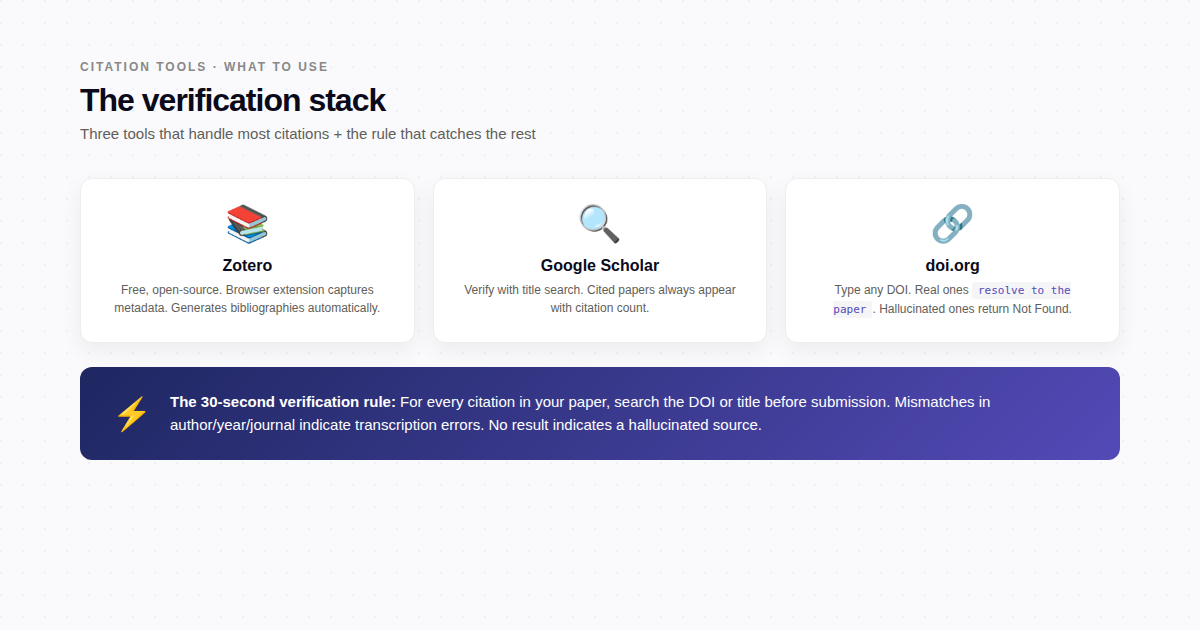
A 30-second verification step solves this. For each citation in your paper, search the DOI on doi.org or search the title on Google Scholar. If the result matches your citation in author names, year, journal, and volume, the citation is correct. If anything is off, fix it before submission.
This catches the most common error in student bibliographies: typing the citation from memory or from another paper that copied it incorrectly. The original source is the source of truth. Always verify against it.
This step is also the strongest defense against AI-generated bibliographies that contain hallucinated entries. If a citation does not resolve to anything verifiable, it does not exist, and including it in your paper is academic misconduct regardless of intent.
Tools that help
A few tools that genuinely save time:
Zotero is free, open-source, and integrates with your browser. When you find a source online, Zotero captures the metadata. When you write, you cite by selecting from your Zotero library. The bibliography is generated automatically.
Mendeley is similar, with stronger PDF annotation features. Free for individual use.
Citation generators built into Google Scholar, library databases, and even some word processors are useful for first drafts but should always be verified. They get the format mostly right but sometimes mistype an author name or skip a DOI.
APA’s own citation guide, published by the American Psychological Association at apastyle.apa.org, is the authoritative reference for any edge case not covered above. It is the only source whose answer is final.
Why citation matters beyond the grade
Citation is not pedantic formatting. It is intellectual honesty made structural. When you cite, you are saying: this idea came from somewhere I can show you, and you can verify it for yourself. The format is a protocol that makes verification possible. Sloppy citation is sloppy thinking, because it suggests the writer does not care whether their claims can be traced to real sources.
This is also why hallucinated citations — the AI-generated invented references that have started appearing in student papers — are such a serious academic problem. They violate the protocol’s purpose. They make claims unverifiable on principle. A bibliography full of invented sources is a paper that cannot be checked, and a paper that cannot be checked is not a paper that participates in academic knowledge.
The four rules above, the edge cases below them, and the verification step at the end produce bibliographies that work. The rest is practice. After two papers, the citation format becomes automatic, and the time you spent learning it pays off across every academic paper you write for the rest of your career.
—
Want a bibliography that always verifies?
Papyra writes academic papers with citations sourced from CrossRef and OpenAlex — every reference is real, every DOI resolves, every author is verifiable. The kind of bibliography that passes any verification check, every time.
