The most common plagiarism is the kind students don’t realize is plagiarism
Most students intend to cite properly. The accidental plagiarism that ends up in academic integrity hearings is rarely deliberate copying. It is something more subtle: a student reads a passage, wants to use the idea, replaces a few words with synonyms, and considers the work “in their own words.”
This is not paraphrasing. It is patchwriting, a term coined by composition researcher Rebecca Moore Howard in 1992 and now used widely in academic integrity literature. Patchwriting takes the original sentence structure, swaps surface-level vocabulary, and presents the result as the writer’s own composition. Most universities classify it as plagiarism. Most students do not realize they are doing it.
The 2018 ICAI (International Center for Academic Integrity) survey of 71,000 undergraduates found that 30% admitted to “paraphrasing or copying a few sentences from any source without citing the source.” A subset of these admissions involved deliberate copying. The larger subset involved patchwriting that the student did not recognize as a violation.
This article is about how to actually paraphrase. The method below produces text that is genuinely your own composition, citation-traceable, and indistinguishable from original writing — because it is original writing.
Why synonym swapping is plagiarism
Before the method, the principle.
Paraphrasing is not about replacing words. It is about reconstructing an idea. When you read a passage and understand it, the understanding sits in your head as a structure of relationships — the central claim, the supporting evidence, the implications, the qualifications. Real paraphrase produces a new sentence that expresses that structure using your own organizing logic.
Synonym swapping does not do this. It preserves the original author’s organizing logic and substitutes vocabulary on top. The result reads as the author’s thinking, expressed in a thesaurus. This is why software like Turnitin’s text-matching algorithms can identify patchwritten passages even when no specific phrase exceeds the matching threshold. The deeper structure is unchanged.
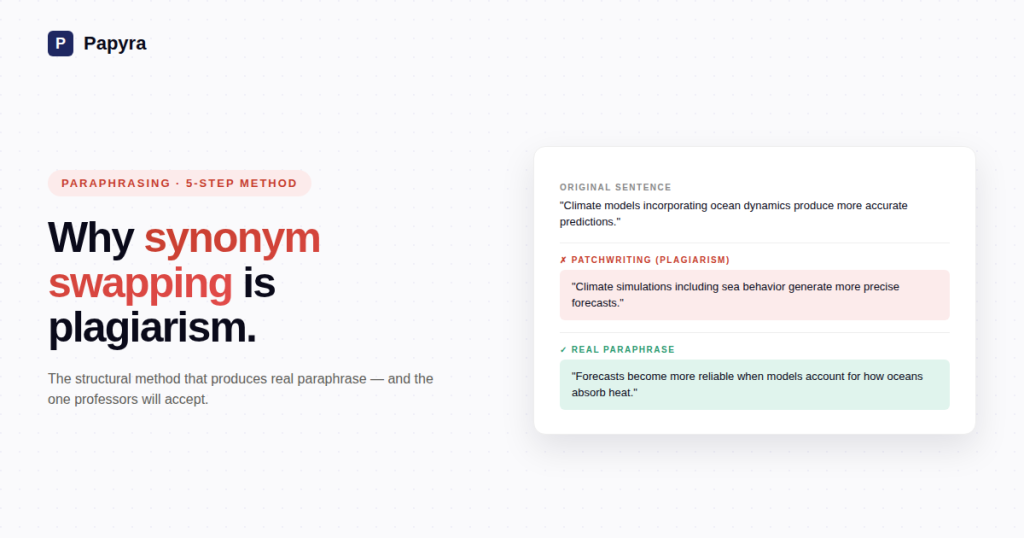
Consider an original sentence:
“Climate models that incorporate ocean thermal dynamics produce more accurate predictions of regional weather patterns than models limited to atmospheric variables alone.”
A patchwritten version:
“Climate simulations that include sea heat behavior generate more precise forecasts of local weather conditions than simulations restricted to atmospheric factors only.”
The structure is identical. Subject, verb, comparative claim, qualification. Only the surface vocabulary has shifted. This is plagiarism in most academic frameworks, even if cited.
A genuinely paraphrased version:
“Regional weather forecasting becomes more reliable when models account for how oceans absorb and release heat, rather than treating the atmosphere as the only relevant system.”
The information is the same. The structure is different — different subject, different verb, different comparison frame. The writer has thought about what the original meant and re-expressed it from a new angle.
The 5-step method
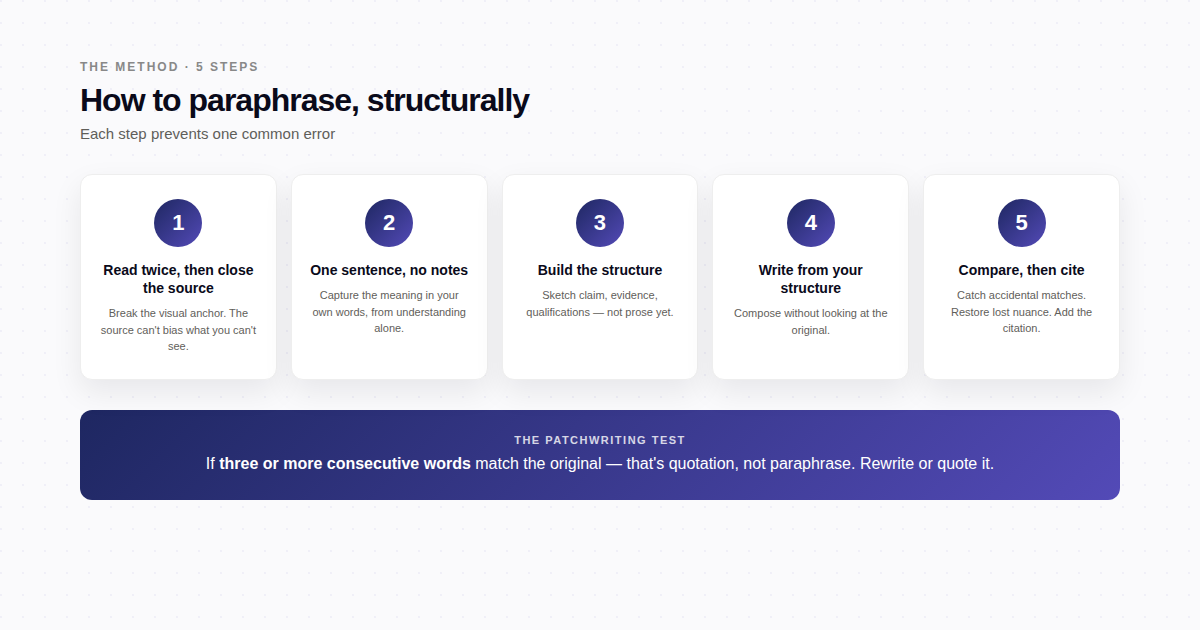
The method below produces real paraphrase. Each step is a discrete action, performed in order, that prevents the most common errors.
Step 1: Read the passage twice, then close the source
The single biggest cause of patchwriting is paraphrasing while looking at the original. When the original is in front of you, your brain anchors to its sentence structure and word choices. Synonym swapping becomes the path of least resistance.
Read the passage you want to paraphrase. Read it again. Then close the document, the browser tab, or the book. Walk away from it for at least 30 seconds. Do something else.
The point is to break the visual anchor. When you return to write, you are working from your understanding of the idea, not from the surface text of the original.
Step 2: Write what the passage means in one sentence, no notes allowed
In a fresh document or notebook, write a single sentence that captures what the passage actually claims. Use only your own words. Do not refer back to the original.
This sentence is usually awkward. It might be longer than the original or shorter. It might miss a nuance. It is a draft. The point is that the sentence comes entirely from your understanding, not from the original text.
Step 3: Expand to the full claim, structure first
Now build out the paraphrase. Start with structure: what is the central claim, what is the supporting evidence, what qualifications belong, what implications follow. Sketch this as a structure, not as prose.
A worked example. Original passage:
“Regular exercise significantly reduces the risk of cardiovascular disease, with the most consistent benefits observed in moderate-intensity activities sustained for at least 150 minutes per week. The mechanism is multifactorial, involving improvements in lipid profiles, blood pressure regulation, and insulin sensitivity.”
Structure:
– Claim: exercise reduces heart disease risk
– Specific finding: 150 min/week moderate intensity is the consistent threshold
– Mechanism: works through three pathways — cholesterol, blood pressure, insulin
Step 4: Write the paraphrase from your structure
Now compose the paraphrase from the structure. Do not look at the original. Use only the structural notes you wrote.
“Cardiovascular disease risk is consistently lower in people who maintain at least 150 minutes of moderate-intensity exercise weekly. Multiple physiological mechanisms appear to contribute to this effect, including changes to cholesterol levels, blood pressure regulation, and insulin response.”
Notice what has changed. The sentence order is different. The subject of the first sentence has shifted from “exercise” to “cardiovascular disease risk.” The list of mechanisms is presented differently. The paraphrase expresses the same information through a different organizational logic.
Step 5: Compare against the original, then cite
Open the original. Compare your paraphrase line by line. You are looking for two things: (1) accidental phrase-level matches that you should rewrite, (2) any nuance you missed and should restore.
If three or more consecutive words match the original exactly, that is direct quotation and must be in quotation marks (or rewritten). Five-word matches are the threshold most plagiarism detectors flag, but the cleaner standard is to keep direct matches limited to deliberate, quoted excerpts.
If you find that nuance was lost, add it — in your own words, integrated with your existing structure.
Then cite. The paraphrase, even though it is in your own words, references someone else’s idea. Citation is required. In APA: (Smith, 2023). At the end of your paper, the full reference goes in the bibliography.
A bibliography that traces back to real sources is the foundation of academic honesty. Papyra’s academic writing tool generates papers with citations sourced from CrossRef and OpenAlex — every reference resolves, every author is real, every paraphrase is anchored to a source you can actually produce.
When to paraphrase, when to quote, when to summarize
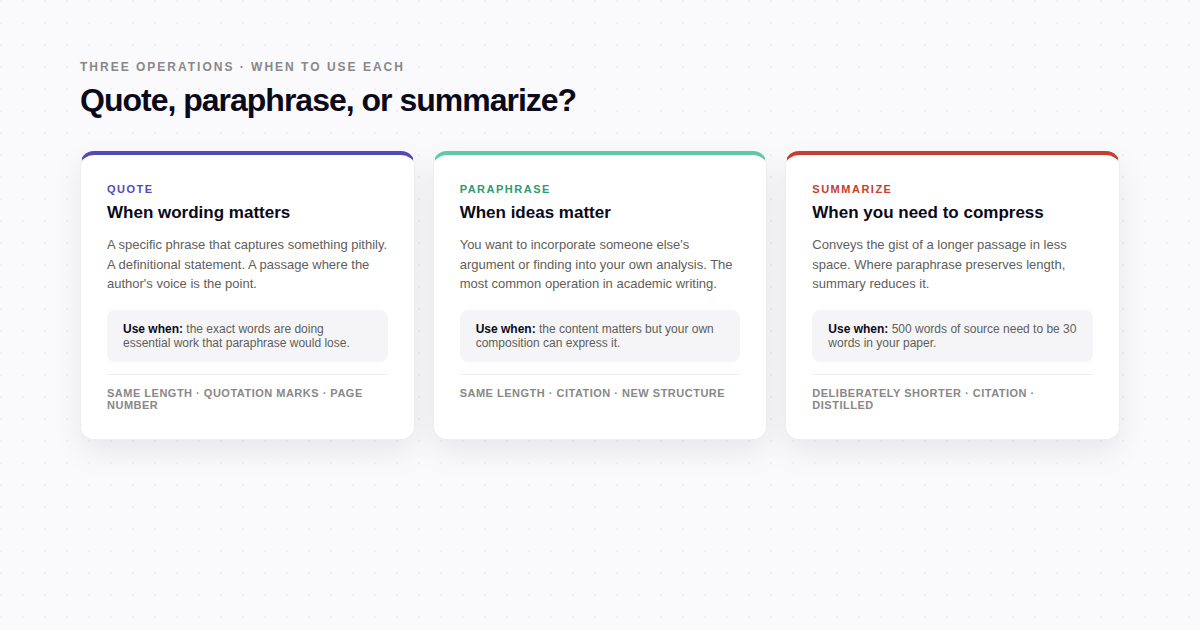
The three operations are different.
Quote when the exact wording matters. A specific phrase that captures something pithily. A definitional statement. A passage where the author’s voice is the point. Direct quotations are always in quotation marks, with page numbers in the citation.
Paraphrase when the idea matters but the wording does not. This is the most common case. You want to incorporate someone else’s argument or finding into your own analysis. Paraphrase preserves the specific content; your own composition expresses it.
Summarize when you need to convey the gist of a longer passage in less space. Summary compresses. Where paraphrase preserves length and detail, summary deliberately reduces. A 500-word section becomes a sentence: “Smith (2023) argues that detection tools systematically misclassify non-native English writers.”
The mistake students often make is paraphrasing when they should be summarizing — taking 500 words and producing 480 words of paraphrase, when 30 words of summary would serve the argument better.
The patchwriting test
After paraphrasing, run the patchwriting test on your work. Place your paraphrase next to the original and ask:
– Sentence structure: Is the order of clauses different? Are subjects different? Are verbs different?
– Vocabulary: Are the key content words different? (Not synonym swaps — actually different conceptual choices.)
– Length: Is the paraphrase noticeably different in length, indicating that the structure shifted?
– Three-word test: Are there any three-word sequences that match the original exactly?
A paraphrase that passes all four checks is real paraphrase. A paraphrase that fails any of them is patchwriting and needs to be redone.
The cases that are genuinely hard
Some technical and definitional passages resist paraphrase because the conventional vocabulary is so specific.
“DNA polymerase III synthesizes the leading strand continuously and the lagging strand discontinuously through the formation of Okazaki fragments.”
There is essentially no way to paraphrase this without losing accuracy. “Okazaki fragments” is the technical term for the structure being described; “DNA polymerase III” is the specific enzyme. You cannot say “the DNA-copying protein” without imprecision.
In these cases, the move is not paraphrase but careful framing. Quote the technical terms exactly, paraphrase around them, and cite. Or quote the entire passage as a definitional statement and proceed to your analysis. What you cannot do is replace “Okazaki fragments” with “discontinuous segments” and call the result paraphrase.
Why this matters more than students realize
Students often treat paraphrase as a citation-format issue — get the in-text reference right and the bibliography entry correct, and you have done your duty. The deeper point is different.
Real paraphrase is evidence of real understanding. When you can re-express someone’s idea in genuinely different language, you have demonstrated that you understood the idea well enough to operate on it. When you can only patchwrite, you have demonstrated that you understood the words but not the structure of the thought.
Professors notice this distinction. The papers that read as patchwritten — paraphrases that hew to the original’s syntax — read as papers where the student processed the source on the surface but did not engage with it. The papers that read as genuine paraphrase — where the student’s prose expresses borrowed ideas through their own organizing logic — read as papers where the student actually thought.
This is why the academic integrity systems care about paraphrase quality even when the citation is technically correct. The signal is not just attribution. It is engagement. A patchwritten paper, even properly cited, is a paper where the engagement is missing.
A worked-through case
Original passage, from a real research paper:
“Recent studies have demonstrated that AI detection tools exhibit systematic bias against non-native English speakers, with false positive rates exceeding 60% in some experimental conditions. This bias appears to result from detectors’ reliance on linguistic features such as vocabulary range and syntactic complexity, which differ predictably between native and non-native English writers.”
A patchwritten version (avoid this):
“Recent research has shown that AI detectors display systematic prejudice against non-native English speakers, with false positive rates surpassing 60% in certain experimental settings. This prejudice seems to stem from detectors’ dependence on linguistic features like vocabulary range and syntactic complexity, which vary predictably between native and non-native English writers.”
The structure is identical. The vocabulary is shifted by single-word substitutions. This would be flagged as plagiarism by most matching algorithms.
A real paraphrase:
“When researchers tested AI detectors on essays by non-native English speakers, false positive rates climbed above 60% in several setups (Liang et al., 2023). The likely explanation is the way detectors score writing — they look at vocabulary breadth and sentence-construction complexity, which are measurably different between groups whose linguistic backgrounds differ.”
Different subject. Different sentence order. The mechanism is described from a different angle (“the way detectors score writing” instead of “detectors’ reliance on linguistic features”). The information is preserved. The structure is genuinely the writer’s own.
This kind of paraphrase takes longer to write than patchwriting, but only by a minute or two. The five-step method, practiced a few times, becomes automatic. The papers that result are immune to plagiarism allegations not because the citations are perfect, but because the writing genuinely is the student’s own.
—
Want academic writing where every paraphrase traces to a real source?
Papyra generates papers with verified citations from CrossRef and OpenAlex. The kind of bibliography where every reference is real, every paraphrase is anchored, and every claim can be traced back to its origin in published work.
