The email that ruins a Tuesday afternoon
You upload a paper. Hours later — sometimes minutes later — an email arrives from your professor. The subject line is some variation of “Concern about your recent submission.” The body is short. It mentions an AI detection tool. It says you have been referred to the academic integrity office. Sometimes it says a meeting is being scheduled. Sometimes it asks you to respond by a deadline.
This email arrives in tens of thousands of student inboxes a year. At Australian Catholic University alone, nearly 6,000 such cases were filed during the 2024 academic year, according to reporting by the Australian Broadcasting Corporation. The vast majority of accused students are guilty of nothing more than using formal academic prose.
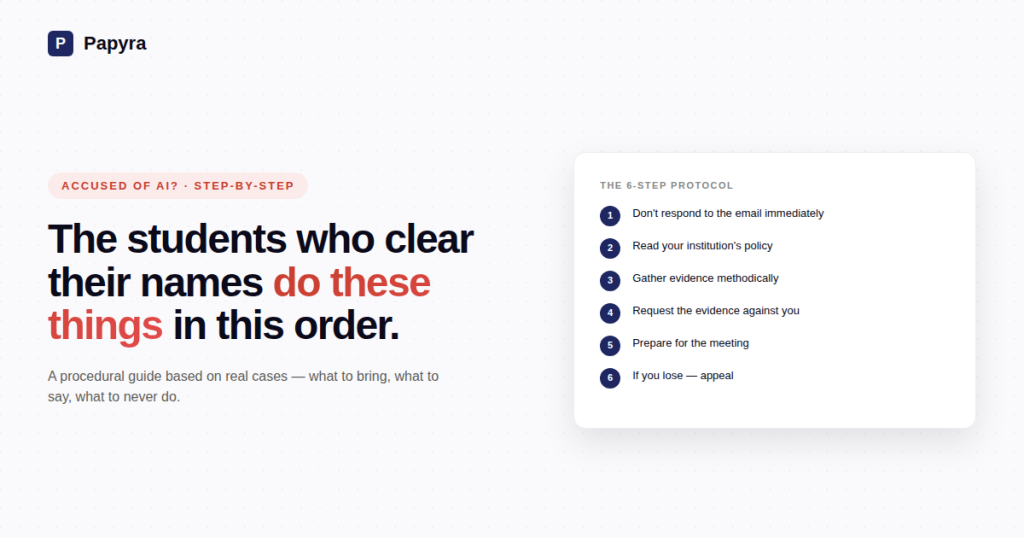
If this email has arrived for you, what comes next is procedural, predictable, and survivable. The students who clear their names do specific things in a specific order. The students who get hurt are usually the ones who panic, delay, or try to handle the case alone.
This is what to do.
Step 1: Do not respond to the initial email immediately
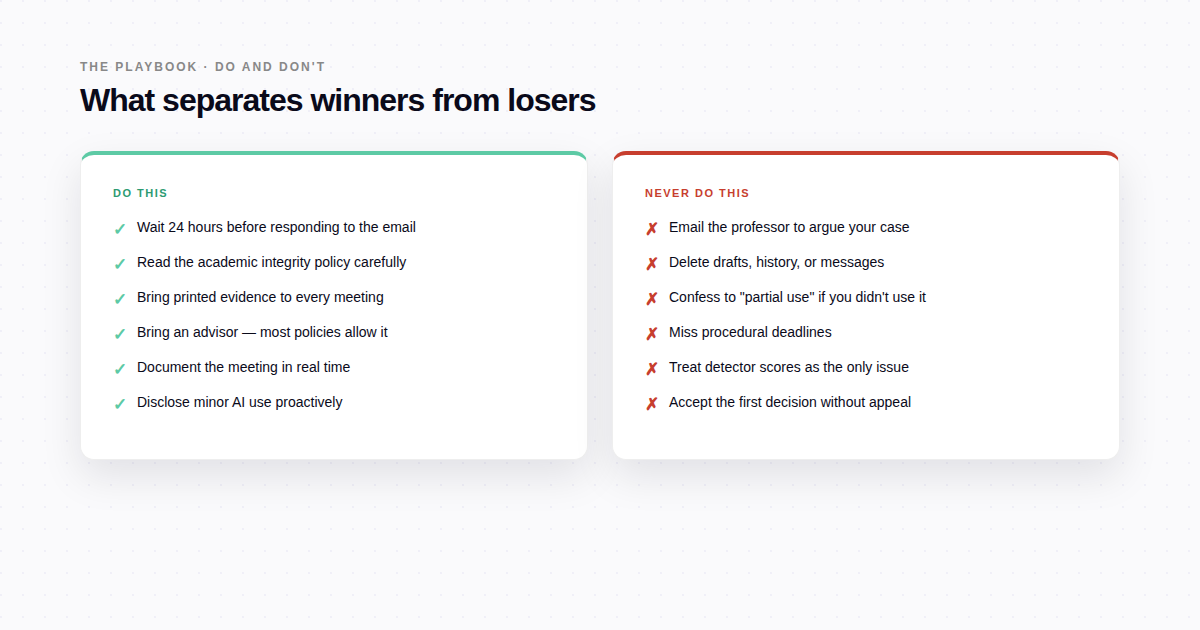
The instinct, especially if you are innocent, is to fire back a denial. Resist that instinct for at least 24 hours.
Anything you write now will become part of the formal record. A reactive, emotional response can be used by the university’s process to suggest you were defensive, evasive, or dishonest — even if you were just upset. Take the time to read the email carefully, identify exactly what is being alleged, and prepare a measured first response.
The first response should be short, calm, and three things only: (1) acknowledge receipt, (2) state that you did not use AI on this assignment, (3) request the specific evidence that prompted the allegation, and the formal procedure that will follow. That last request is critical. Most universities are required to provide both, in writing.
Step 2: Read your institution’s academic integrity policy
Within the same 24 hours, find the policy document on your institution’s website. It is almost always public. Read it twice.
You are looking for three specific things:
– The standard of proof. Is the university required to prove the allegation beyond a reasonable doubt, or by a preponderance of evidence, or by some other standard? This determines what you actually have to defend against.
– The role of detection tools. Most modern policies explicitly state that AI detection scores cannot serve as the sole evidence of misconduct. If your institution has this rule and your case rests on a Turnitin or GPTZero score alone, you have grounds for immediate dismissal of the case.
– Your rights at the hearing. Many policies grant you the right to bring an advisor, to review evidence in advance, to call witnesses, and to appeal. Knowing these rights before the meeting is leverage.
Print the relevant sections. Highlight what applies to your case. Bring it to every subsequent conversation.
Step 3: Gather your evidence — methodically
This is the step that wins cases. The students who walk out of academic integrity meetings cleared are almost always the ones who arrive with evidence the university did not expect them to have.
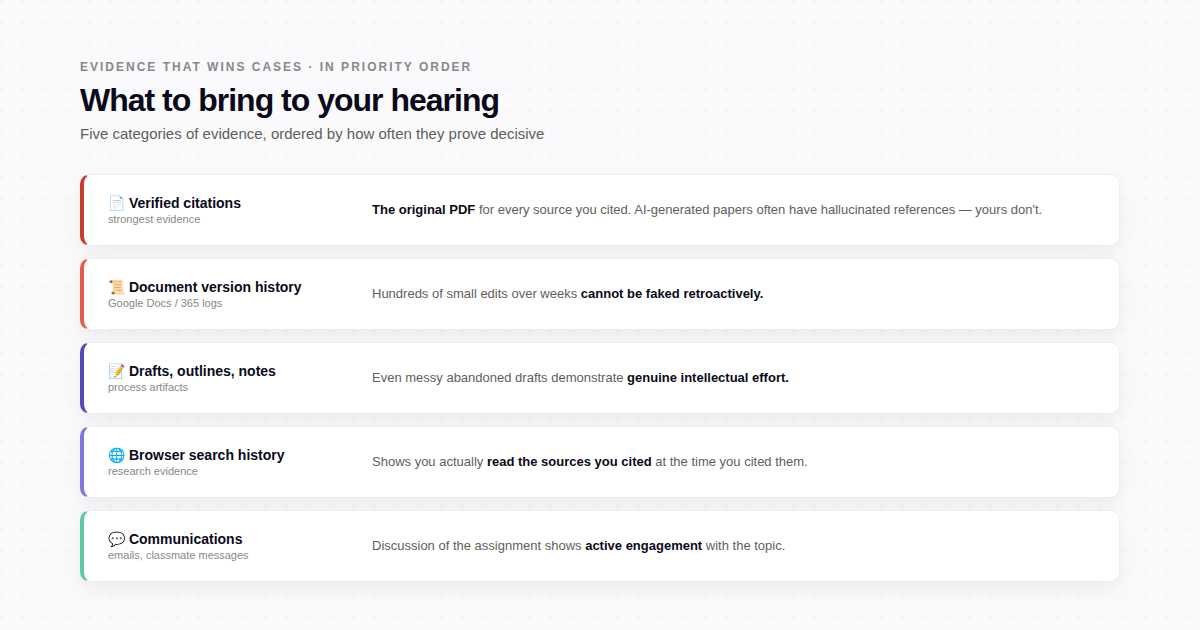
The evidence you want, in priority order:
Document version history. Google Docs and Microsoft 365 both log edits automatically and let you export a complete revision timeline. Open the document, navigate to the version history menu, and screenshot every major checkpoint with timestamps. A document showing 200 small edits across two weeks cannot plausibly be confused with single-session AI output.
Drafts, outlines, and notes. Anything you produced during the writing process — handwritten notes, abandoned paragraphs, an outline you scribbled on the back of an envelope — is evidence. If your university uses an LMS like Canvas or Blackboard, check whether earlier drafts are stored there.
Source PDFs. For every paper you cited, locate the actual PDF or web archive. Organize them in a folder matching your bibliography order. The ability to produce, on demand, the original source for every citation in your paper is the cleanest possible refutation of any allegation that you fabricated references.
Search history. Your browser history showing you reading the sources you cited is corroborating evidence. Most browsers let you export history within a date range. If your university’s accusation is based on the suggestion that you could not have known about specific sources, this is direct contradiction.
Communications about the assignment. Emails to professors asking clarifying questions, messages to classmates discussing the topic, posts in course discussion forums — anything showing you engaged with the assignment as a thinking person.
Verified citations are your strongest defense. Papyra’s academic writing tool generates papers where every reference is matched to a real, published source through CrossRef and OpenAlex — a bibliography you can produce on demand, with working DOIs, when the integrity office asks how you found these papers.
Step 4: Request the evidence against you
Most academic integrity procedures require the university to share, in writing, the specific evidence that prompted the allegation. If they have not provided this, request it formally.
You want to know:
– Which specific tool flagged your work
– The exact percentage or score the tool produced
– Which sentences or sections were flagged
– Whether any human reviewer also assessed the work, and what that reviewer concluded
– Whether the tool’s output was the sole evidence, or whether other concerns were raised
Once you have this, you can challenge it specifically. If the only evidence is a Turnitin AI score, point out — using your institution’s own policy — that detection scores cannot serve as standalone evidence. If the score is below the tool’s own published reliability threshold, point that out. If the flagged passage uses formal language similar to academic conventions, demonstrate that those conventions appear in published academic literature.
Step 5: Prepare for the meeting
Most academic integrity processes culminate in a meeting — sometimes called an interview, hearing, or panel. This meeting will go better if you treat it as a professional procedure, not an emotional confrontation.
Bring printed copies of:
– The accusation email
– The relevant sections of your institution’s policy
– All the evidence you gathered in Step 3
– A short written statement of your position
Bring an advisor if your policy permits. At many institutions, this can be a faculty member, a student advocate, or a campus ombudsperson. Some institutions allow lawyers in formal hearings. Use this right.
In the meeting, answer questions clearly and concisely. Do not volunteer information beyond what was asked. If you are unsure how to answer something, say so and ask for time. If a question is leading or assumes guilt, push back politely: “I haven’t agreed to that characterization.”
The Yale case from 2025 — a French executive MBA student who is now suing the university — included specific allegations that university officials “made multiple attempts to coerce a false confession” during preliminary meetings. If you feel this is happening to you, document it in real time. Take notes. If your institution permits, record the meeting (with appropriate notice).
Step 6: If you lose, appeal
Almost every academic integrity process has an appeal mechanism. The grounds for appeal are usually narrow — procedural error, new evidence, disproportionate sanction — but they are real.
If the initial decision goes against you, do not accept it. Read the appeal procedures carefully, file within the deadline, and structure your appeal around specific procedural failures or new evidence rather than re-arguing the merits. Appeals that succeed almost always succeed on procedure, not on persuasion.
If your institution’s internal appeal fails and you believe the process was fundamentally unfair, external options exist. The Newby case at Adelphi University ended in February 2026 when a New York state court ordered the university to expunge the student’s record entirely, after finding that the disciplinary process had been arbitrary. The Yale lawsuit is testing similar grounds at the federal level.
What you should not do
Do not contact the professor directly to argue your case before the formal process begins. This often backfires. Channel everything through the academic integrity office.
Do not delete anything. Your draft files, your search history, your messages — preserve everything until the case is fully resolved. Deleting evidence, even innocent evidence, can be characterized as obstruction.
Do not confess to “partial use” of AI if you did not use it. Some students confess to minor AI use (asking ChatGPT to define a word, using grammar correction) thinking it will appear cooperative. It does not. It opens a new line of inquiry and makes you appear unreliable.
Do not delay. Academic integrity processes have deadlines. Missing one usually means losing by default.
The data that should comfort you
Despite the volume of accusations, most cases involving AI detection are dismissed when properly contested. The Australian senior official who admitted that “any case where Turnitin’s AI detection tool was the sole evidence was dismissed immediately” was describing the typical outcome, not an exception.
Universities that have studied their own detection-driven referral patterns have found false positive rates in the 1-5% range overall, with much higher rates for non-native English speakers and neurodivergent students. The institutional appetite for these cases is declining. Vanderbilt, Johns Hopkins, the University of Pittsburgh, and others have already disabled Turnitin’s AI detector entirely.
If you are accused, you are not alone, you are not necessarily losing, and the procedure is survivable. The students who clear their names do it methodically. So can you.
—
Want every citation in your work to be defensible?
Papyra writes academic papers where every reference is verified against published sources through CrossRef, OpenAlex, and Semantic Scholar. The kind of bibliography you can produce on demand when the integrity office asks how you found these papers.
