The wrong question, and the better one
“Is using AI cheating?” is the question most students ask. It produces a long argument with no useful conclusion, because the answer depends on which AI use, which institution, which assignment, and which professor. The Modern Language Association’s 2024 task force report acknowledged that “no single answer can apply across all academic contexts.”
The better question, and the one this article is about, is: Which uses of AI are defensible to a thoughtful professor, and which are not?
This question has a usable answer. The framework below is built from current academic integrity research, published institutional policies, and the patterns that hold up consistently across courses, disciplines, and disciplinary cultures. It is not a list of permissions. It is a way of thinking about the question that produces decisions you can defend.
The dimension that actually matters
Every academic integrity researcher who has written about generative AI in the past two years converges on the same distinction. It is not “did you use AI” — that question is now too vague to be useful. It is “what intellectual labor was performed, and by whom?”
When you write a paper, you are doing several distinct things:
1. Choosing what to argue
2. Identifying what evidence supports your argument
3. Reading and understanding that evidence
4. Synthesizing the evidence into a coherent case
5. Writing the case in your own words
6. Editing and refining the writing
The conventional model of academic writing assumes the student does all six. The AI-assisted model splits the labor — sometimes responsibly, sometimes not.
The dividing line is whether the thinking is yours. AI can prepare materials, suggest structures, polish prose, or summarize background. AI cannot perform the synthesis or argument that constitutes the actual academic work. When students cross that line, they have not just used AI — they have outsourced the thing the assignment was meant to evaluate.
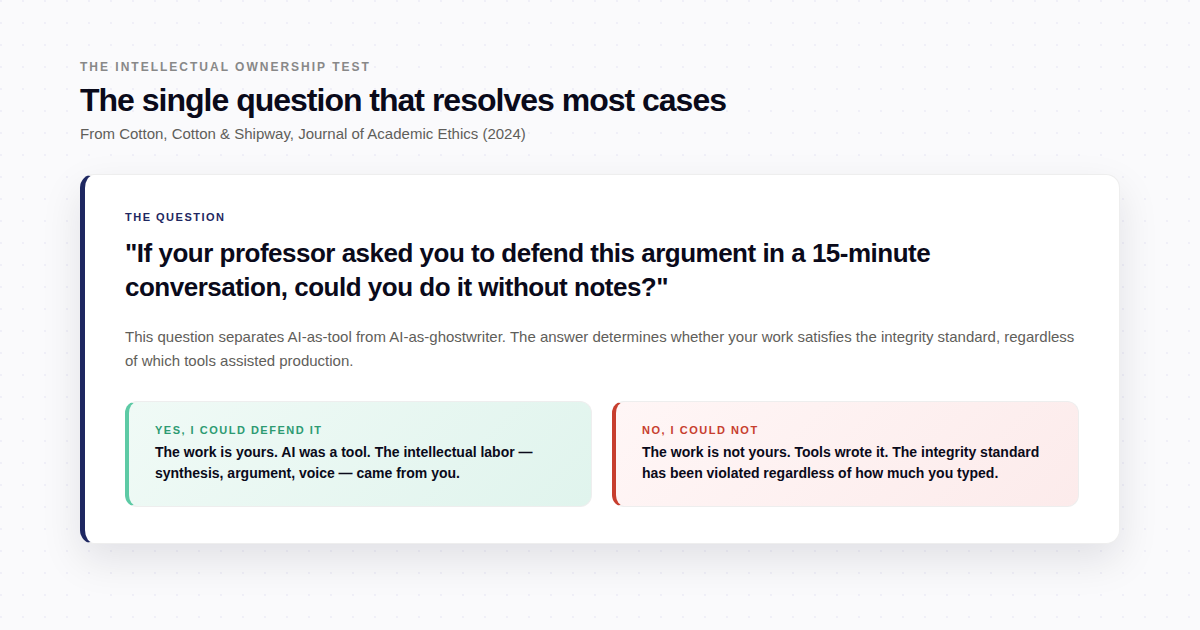
A 2024 paper in the Journal of Academic Ethics by Cotton, Cotton, and Shipway formalized this distinction as the “intellectual ownership test.” If a professor asked you, after submission, to talk through your argument and respond to objections to it, could you do so coherently? If yes, the work is yours, regardless of what tools assisted production. If no, the work is not yours, regardless of how much you typed personally.
The framework, in seven concrete cases
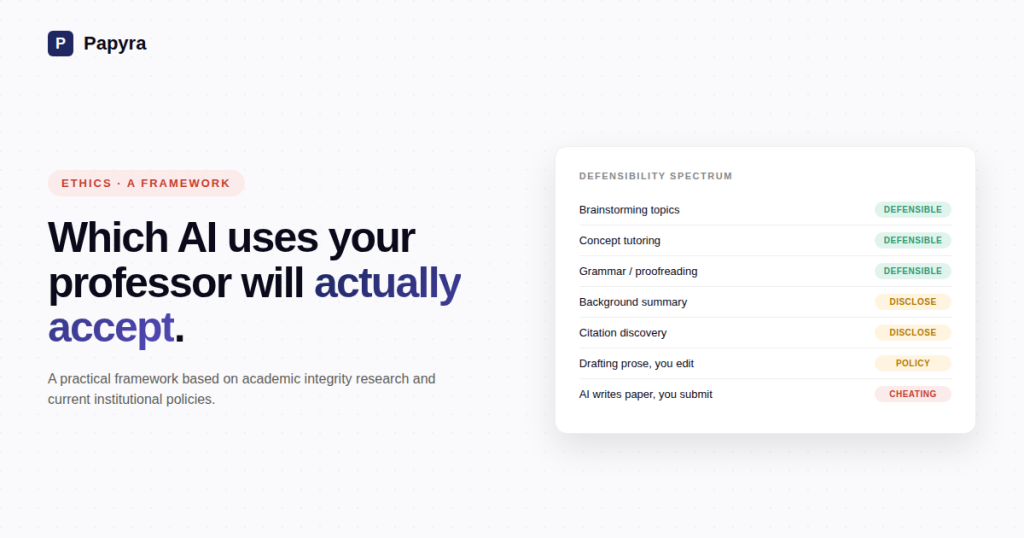
What follows are seven specific uses of AI in academic work, ordered from clearly defensible to clearly not. The cutoff between defensible and not depends on context, but the ordering is robust across institutions and disciplines.
Defensible in almost any context
1. Brainstorming and topic exploration. You ask ChatGPT for ten possible angles on the question of urban renewal in mid-century American cities. You read the suggestions, discard most, and pursue one. The AI helped you find a starting point, not write the paper. This is functionally identical to brainstorming with a friend, which has never been considered cheating.
2. Explanation and tutoring. You read a paper on Nash equilibria and do not understand a particular proof. You ask ChatGPT to explain it in simpler terms. The AI is acting as an on-demand tutor, not a co-author. This is identical to attending a TA session.
3. Grammar and proofreading. You finish a draft and ask AI to identify grammatical errors and awkward phrasing. The arguments, evidence, structure, and synthesis are all yours. The AI is doing copy-editing work. This is what your campus writing center does, performed by a different agent.
Defensible work needs defensible sources. Papyra’s academic writing tool generates papers with verified citations from CrossRef and OpenAlex — the sourcing layer that even ethical AI use cannot produce reliably with general-purpose chatbots.
Defensible with disclosure
4. Background summary. You ask AI to summarize the literature on a topic so you can quickly orient yourself before reading the actual papers. As long as you read the actual papers, this is similar to reading an encyclopedia entry. Most professors accept this with disclosure. Without disclosure, it can read as substituting AI summary for actual reading.
5. Citation discovery. You ask AI for a list of relevant papers on your topic. Then you find the papers, read them, and cite them yourself. This is research assistance. The risk, well-documented in the Mata v. Avianca case and academic literature, is that general-purpose chatbots hallucinate citations — invent papers that do not exist. If you use AI for citation discovery, you must verify every result before incorporating it. Tools designed specifically for academic work, like Papyra, retrieve verified citations from real databases instead of generating them.
Defensible only with explicit policy permission
6. Drafting prose with significant editing by you. You ask AI to draft a paragraph, then you rewrite it substantially in your own words, integrating it with your own analysis. Some institutions explicitly permit this. Most do not. The intellectual work — synthesis, argument, voice — must remain yours, and the AI-derived prose must be small enough that the final voice is recognizably yours. Without policy permission, this is risky.
Not defensible
7. AI generates the paper, you submit it. This is straightforwardly academic dishonesty in every published institutional policy. It violates the intellectual ownership test (you cannot defend an argument you did not construct), it removes your learning entirely, and it is what the assignment was actually meant to evaluate.
The shorthand: if you cannot pass an oral exam on the content of your own paper, you have crossed the line.
What about courses that ban AI entirely?
Some courses prohibit any AI use. This is a defensible policy — there are good pedagogical reasons to require students to grapple with material directly, especially in introductory courses where the goal is skill development. If your course has this policy, follow it.
The hard cases are courses that do not have explicit policies. The default assumption in 2026 should be that unstated policies lean restrictive. If you are unsure, ask the professor in writing. An email saying “I’d like to use ChatGPT to help me brainstorm topics — is that okay for this assignment?” produces a paper trail that protects you regardless of the answer.
If the professor says yes, you have explicit permission. If the professor says no, you have clarity. If the professor does not respond, you have evidence that you tried to clarify, which weighs in your favor in any subsequent dispute.
The disclosure question
Many institutions are converging on a norm of light disclosure — a single line in the paper or methods section noting that AI was used and how. The Modern Language Association’s 2024 guidance suggests something like: “I used ChatGPT-4 to brainstorm initial topic ideas. All research, analysis, and writing are my own.”
Disclosure costs you almost nothing. It costs you time and a sentence. It buys you protection — if a question comes up later, your disclosure is on record and you have already been transparent. Students who disclose, even when they do not strictly have to, almost never end up in academic integrity hearings over the disclosed use.
Students who use AI without disclosing, and then are asked, end up in much worse positions. The Yale case from 2025, where the executive MBA student is suing over a wrongful AI cheating accusation, includes specific allegations about the university’s discovery process — once the student was accused, every aspect of his work history was scrutinized. Disclosure preempts that scrutiny.
The pragmatic test
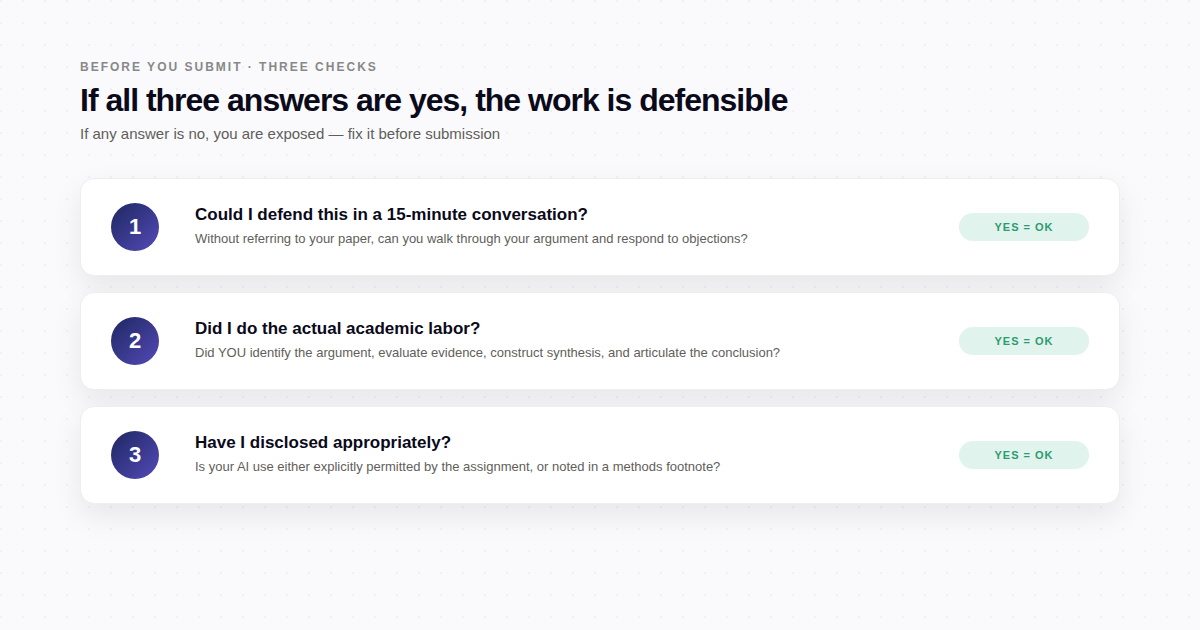
Before submitting work that involves AI assistance, run three checks:
Could I defend this work in a 15-minute conversation with my professor? If a professor asked you to walk through your argument and respond to objections, could you do it without referring to your paper? If yes, the work is yours.
Did I do the actual academic labor? Did I identify the argument, evaluate the evidence, construct the synthesis, and articulate the conclusion? If those four things came from me, AI was a tool. If any of them came from AI, AI was a co-author.
Have I disclosed appropriately? Is my AI use either (a) within the explicit permission of the assignment, or (b) disclosed in a methods note or footnote?
If all three answers are yes, the work is defensible. If any is no, you are exposed.
Why this framework will hold
The institutional response to AI in academic work is still evolving, but the principles are stabilizing. Universities are not converging on bans — they are converging on permission-with-disclosure. Detection is becoming less reliable, not more, as AI improves. The locus of integrity assessment is shifting from “did you use AI” to “is the work yours.”
This framework is not optimistic about institutions. It is realistic about them. The institutions that win the next decade of integrity policy will be the ones whose rules track the intellectual ownership test, because that is the only test that survives contact with rapidly improving AI tools.
The students who win the next decade are the ones who use AI as a collaborator on tasks where collaboration is appropriate, who disclose appropriately, and who can always defend their own arguments. The framework above is what that looks like in practice.
—
Want academic writing where you stay the author?
Papyra generates papers with verified citations and clean structure — but the argument, the synthesis, and the voice remain yours. The kind of AI-assisted writing you can defend in any conversation about academic integrity.
