The Adelphi case, and what it changed
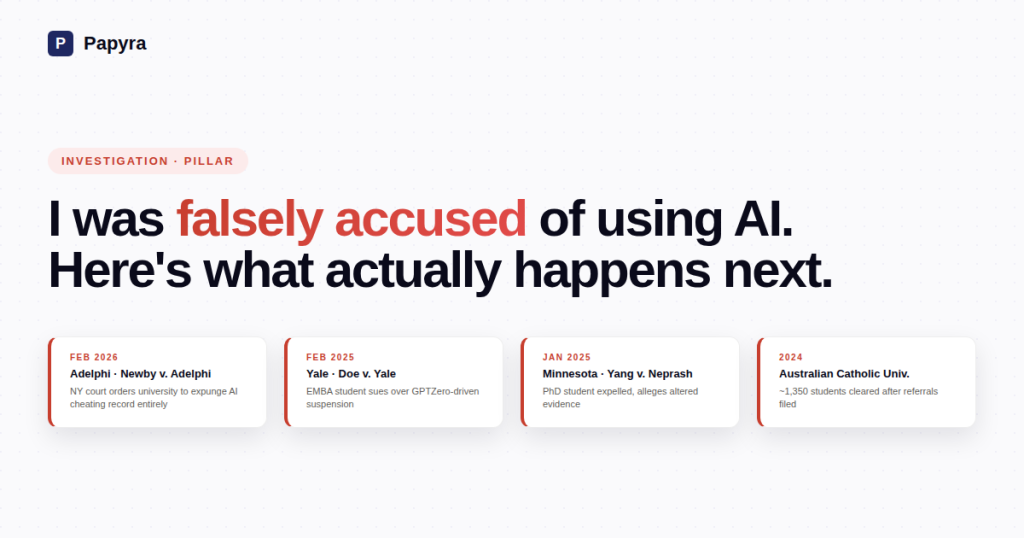
In February 2026, a New York state court issued an order that will likely shape American academic integrity policy for years.
The case involved Orion Newby, an undergraduate at Adelphi University on Long Island. Newby had submitted a paper to one of his professors. The professor ran it through an AI detection tool. The tool flagged the paper. Newby was charged with academic misconduct.
What complicated the case is that Newby is a student in Adelphi’s Bridges program — a support service for students with learning and neurological differences. Tutors in the Bridges program had assisted with the paper, as they do with all his work. The professor, when shown evidence of this collaboration, did not retract the charge. A first disciplinary panel upheld it. A second alleged offense was filed. Expulsion was on the table.
His parents hired a lawyer. The case went to the New York State Supreme Court. In February 2026, Justice Catherine M. DiDomenico ordered the university to vacate the disciplinary findings entirely and to expunge the entire record of the proceeding. The court found that the university’s process had been “arbitrary and capricious” — that an AI detection score, by itself, did not constitute reliable evidence, and that a process built around such evidence violated the student’s due process rights.
The court’s ruling is being called groundbreaking. Mark Lesko, the former U.S. attorney representing the family, told CBS New York that “higher education needs to take a very careful look at this.” A growing number of legal observers expect the decision to be cited in future cases.
But what should make every student pay attention is not the legal precedent. It is the path Newby’s family had to take to clear his name: hire a lawyer, file a lawsuit, wait four months, win in court. The ordinary academic integrity process inside the university could not produce a fair outcome on its own. The case had to escape the institution before it could be resolved.
For most students, that path is not available. Most students cannot afford a lawyer. Most students do not want to sue their university. Most students just want to graduate.
This article is for those students. It is the data, the cases, and the framework you need to understand what is happening, why it keeps happening, and how to defend yourself if it happens to you.
—
How big is the problem
The numbers, as of late 2025, are larger than most people realize.
In October 2025, Australian Catholic University disclosed to the Australian Broadcasting Corporation that it had referred nearly 6,000 cases of alleged academic misconduct during the 2024 academic year. Approximately 90% of those referrals — about 5,400 cases — involved alleged AI use. About one in four of the AI-related referrals were dismissed after investigation, meaning roughly 1,350 students were investigated and cleared. Each of those students went through weeks of formal proceedings and document production for an allegation that should never have been filed.
ACU is one institution. The Australian higher education sector includes 39 publicly funded universities. The U.S. system includes nearly 4,000 institutions. The U.K., another 160. If ACU’s pattern holds even approximately at scale — and there is no obvious reason why it would not — the number of students globally who are accused of AI-assisted cheating each year is in the hundreds of thousands. The number falsely accused is in the tens of thousands.
The empirical basis for this estimate is the documented false positive rate of AI detection tools. The Stanford study by Liang and colleagues, published in Patterns in July 2023 (DOI: 10.1016/j.patter.2023.100779), found seven of the most widely used AI detectors misclassified essays by non-native English speakers as AI-generated 61.22% of the time. Native English speakers’ essays were classified correctly at near-perfect rates. The bias was not subtle. It was the size of a coin flip.
The students this hits hardest are exactly the populations universities should be most cautious about disciplining incorrectly: international students whose visa status depends on academic standing, neurodivergent students who already navigate institutional processes that were not designed for them, first-generation students without family experience of academic dispute resolution.
A bibliography that can be defended is the strongest evidence you have. Papyra’s Document Correction tool generates academic work where every citation traces back to a real, published paper through CrossRef and OpenAlex — the kind of paper trail that ends an integrity meeting in five minutes.
—
The Yale case, the Minnesota case, and what they reveal
Two ongoing federal lawsuits illuminate the depth of the problem.
In February 2025, an executive MBA student at the Yale School of Management — a French entrepreneur and investor in his second-language environment — filed suit against Yale, alleging he had been wrongfully suspended on the basis of a GPTZero detection score. The complaint, Doe v. Yale University, 3:25-cv-00159 (D. Conn.), is the first known federal lawsuit alleging that a university violated civil rights laws through AI-detection-driven discipline.
The lawsuit’s specific allegations, drawn from public filings, are striking. The plaintiff, identifying himself as John Doe, alleges that university officials “made multiple attempts to coerce a false confession of violating the Honor Code.” When the plaintiff resisted, an official allegedly suggested that “his F1 visa could be revoked, and he could be deported, as a result of the Honor Committee investigation.” (The plaintiff was not, in fact, on an F1 visa.) When the plaintiff submitted GPTZero scans of academic papers written by Yale faculty — including former University President Peter Salovey — to demonstrate that the detector flagged human-written academic prose with regularity, the Honor Committee proceeded with sanctions anyway.
The case is pending. Yale’s attorneys have moved to dismiss; the court has not yet ruled on the motion. Whatever the outcome, the public filings have already done damage to the institution’s claim that detection-driven discipline is a fair process.
The University of Minnesota case, Yang v. Neprash et al., filed in January 2025, raises different but related concerns. A second-year PhD student in Health Services Research, Haishan Yang, was expelled in late 2024 after professors accused him of using AI on a take-home preliminary exam. The university’s evidence was a comparison between Yang’s exam answers and ChatGPT-generated answers to the same questions, which professors had run themselves.
Yang’s lawsuit alleges that the professors altered the ChatGPT outputs between the version originally circulated among faculty and the version presented at his disciplinary hearing — that, in his words, “they kept generating and generating until ‘wow, it’s more similar.'” Yang has identified ten specific differences between the two versions. His expulsion canceled his student visa, ending his academic career in the United States.
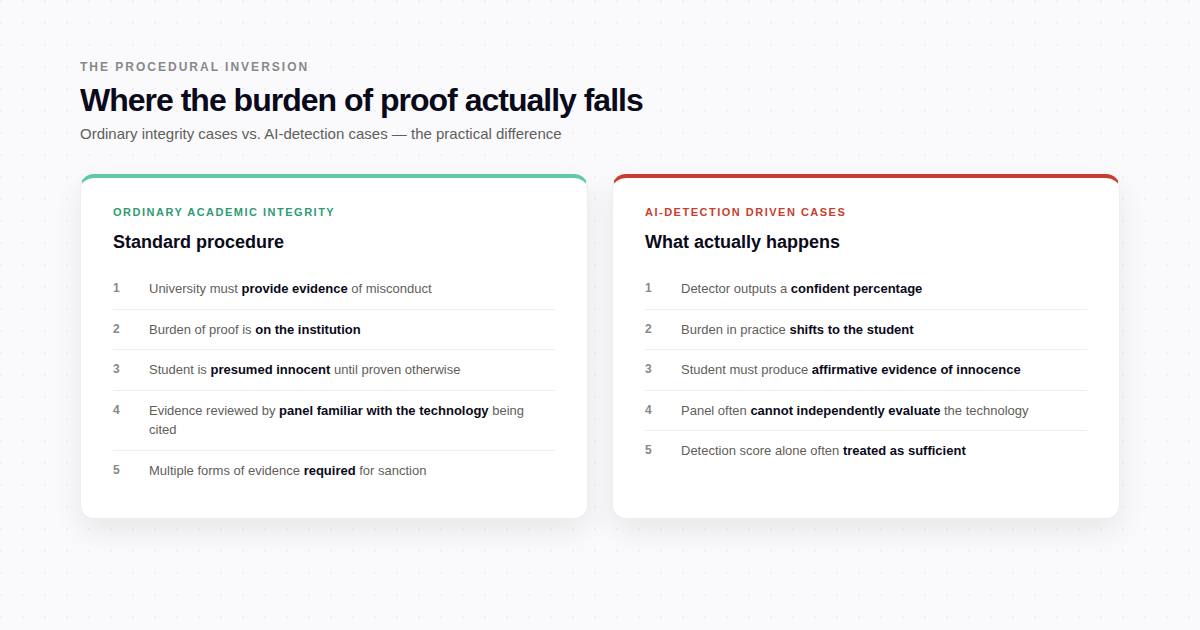
These cases are not aberrations. They are the visible tip of a procedural problem: when AI detection score becomes the primary evidence, the institutional process tends to default to confirmation. The student is presumed guilty until they can produce dispositive contrary evidence. The standard inverts.
—
Why detection-based discipline keeps producing wrong answers
The technical reasons are well-documented. AI detectors score text based on statistical regularities — perplexity, burstiness, predictability — that are present in machine-generated text and largely absent in idiosyncratic human writing. The problem is that some humans write in ways that are statistically similar to machine output. Non-native English speakers do, because their vocabulary range and sentence-construction conventions are necessarily more constrained. Neurodivergent writers do, because their writing often features structural regularities and repetitive phrasing patterns that detectors are tuned to flag. Polished, formally-trained writers do, because their writing has the smooth predictability that detectors interpret as machine-like.
In other words, the detectors do not distinguish between AI and human — they distinguish between statistically distinctive and statistically conventional. Anyone whose writing falls in the conventional category, for any reason, is at elevated risk of being flagged.
The institutional reasons are organizational. Universities buy detection tools that promise high accuracy. Faculty who suspect a student has used AI are presented with a tool that produces a confident-looking percentage. The percentage gets entered into the academic integrity referral. The student is then required, in proceedings often presided over by faculty unfamiliar with the technical limitations of the tool, to overcome the score with affirmative evidence of authenticity.
This is the procedural inversion. In ordinary academic integrity cases, the burden of proof is on the institution. In AI-detection cases, in practice, the burden often falls on the student to prove their innocence — to produce drafts, document version history, search records, and explain stylistic choices in ways that satisfy a panel that cannot independently evaluate the technology being used against the student.
The Newby ruling and the pending Yale case are pushing back on this inversion. But change in academic policy is slow. In the meantime, the burden remains on students.
—
The framework that wins these cases
The students who clear their names — at every institution, in every documented case — do roughly the same things. The framework below is built from interviews with attorneys handling these cases, from public court filings, from published institutional case dispositions, and from the patterns that hold across hundreds of accusations.
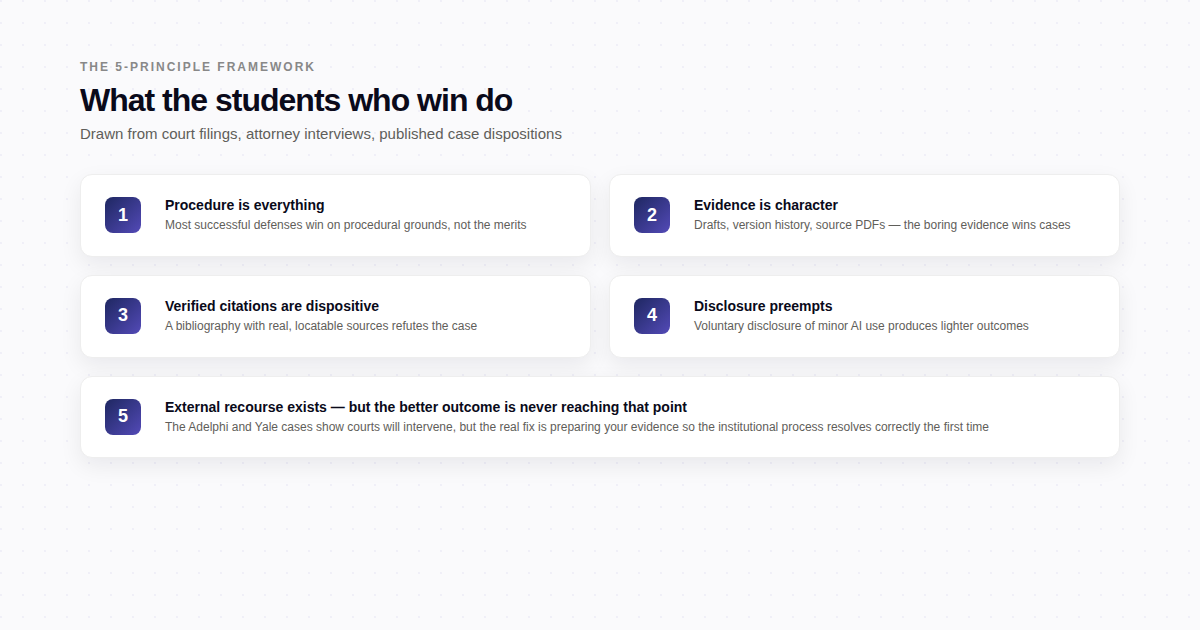
One: Procedure is everything
Most academic integrity cases that succeed for students succeed on procedural grounds, not on the merits of whether AI was used. Read your institution’s policy carefully. Identify every procedural protection you are entitled to: notice of the specific allegation, access to the evidence, the right to bring an advisor, the right to call witnesses, the right to appeal, the standard of proof. If any of these protections were violated in your case, that is the strongest possible ground for dismissal.
Two: Evidence is character
The strongest evidence is the most boring evidence. A document with version history showing 200 small edits over two weeks. A folder with the PDFs of every source you cited. A search history showing you reading the relevant literature. Browser history showing access to library databases. Email exchanges with classmates about the assignment. None of these individually proves anything. Collectively, they create an evidence pattern that is impossible to fake retroactively.
The students who lose these cases are usually the ones who did not preserve this evidence. The students who win are the ones who can produce it on demand.
Three: Verified citations are dispositive
The single fastest way to refute an AI-cheating allegation is to demonstrate that every citation in your paper is real. AI tools that hallucinate sources — and most general-purpose chatbots do — leave students with bibliographies they cannot defend. A student whose every citation resolves to a verifiable, published paper has produced evidence that no detection score can override.
The architectural distinction matters here. General-purpose chatbots like ChatGPT generate citations in plausible formats. They do not retrieve them from real databases. The DOIs may not exist. The journal titles may be slightly wrong. The authors may not have written what is attributed to them. Tools designed specifically for academic work — including Papyra’s citation engine — operate differently. They retrieve actual records from CrossRef, OpenAlex, and Semantic Scholar before any reference is incorporated into a draft. The output is a bibliography that always passes source verification.
If you are accused, and you can produce the original PDF for every citation you used, you have just refuted the case in a way that almost no panel will continue to dispute.
Four: Disclosure preempts
Students who voluntarily disclose AI use — even minor use — tend to fare better than students who deny use that turns out to have happened. Universities have begun to develop “voluntary disclosure” provisions that result in lighter consequences or no consequences at all. If you used any AI in your work, even for grammar checking, disclosing this proactively, before the question is raised, is almost always the better procedural position.
Five: External recourse exists
The Adelphi ruling confirmed that state courts will, in some circumstances, intervene in academic discipline. The Yale case is testing federal civil rights claims. If your institutional process produces an outcome you believe is wrong, and the appeal route within the institution has been exhausted, external legal options exist. They are expensive. They are slow. But they exist.
For students who cannot afford private counsel, several student advocacy organizations have begun to develop expertise in AI-detection cases. The Foundation for Individual Rights and Expression (FIRE) maintains a list of resources for students facing academic disciplinary action. Several state-level higher-education ombudspersons now handle AI-detection complaints specifically.
—
What institutions should be doing, but mostly are not
The structural fix for false-positive AI accusations is not better detection. It is better procedure. Detection tools, by their statistical nature, will always have non-trivial error rates on the populations whose writing they were not trained to evaluate. The fix is to require multiple independent forms of evidence before an academic integrity case can proceed, and to ensure that the burden of proof actually rests on the institution.
Some institutions have begun this shift. Vanderbilt, Johns Hopkins, the University of Pittsburgh, and the University of British Columbia have all disabled or significantly restricted Turnitin’s AI detector. The University of Michigan formally advises faculty against using detection scores as sole evidence. The University of Minnesota’s Center for Academic Excellence has issued guidance specifically warning against the procedural inversion described earlier.
But most institutions have not made these changes. Most still license detection tools, still treat scores as significant evidence, still place the practical burden of proof on the student. Until that changes — through accumulated court rulings, policy reform, or accumulated institutional embarrassment — the falsely accused will continue to be accused.
—
What this all means for you
If you are a student today, the practical situation is this:
1. Your work may be flagged by an AI detector even if you did not use AI. This is not unusual. The Stanford data suggests the rate is not in single-digit percentages.
2. If you are flagged, the institutional process you face will tend to assume you are guilty until you produce dispositive contrary evidence.
3. The evidence that makes a difference is procedural and documentary: drafts, version history, source PDFs, search records, communications.
4. The evidence that is most overlooked, and most powerful, is the bibliography itself. Verified citations that resolve to real, locatable papers refute the entire premise of AI-driven generation.
5. If your institution makes the wrong call, external recourse exists, but it is expensive and slow. The better outcome is to never reach that point.
6. The systemic fix is procedural reform. It is happening, slowly. Until it has happened fully, the burden falls on you to defend yourself.
—
How to write in ways that protect you
The behavior that protects students is not avoiding AI. It is producing evidence as you write.
Use platforms with version history. Google Docs and Microsoft 365 both log edits automatically. Make sure your version history is enabled and exportable.
Save your sources. Every paper you cite, save the PDF. Organize them in a folder by paper number.
Write incrementally. A document built up over days or weeks, with hundreds of small edits, is essentially impossible to confuse with single-session AI output.
Verify every citation. Before you submit, check that every reference resolves to a real, published paper. Hallucinated citations are the single fastest way to lose your case.
Disclose AI use. Even minor use. A single line in a methods section noting how AI was used preempts almost all subsequent questions.
The detectors will keep being wrong. The institutions will be slow to fix their procedures. The falsely accused will keep being accused. But the students who walked through the framework above — every one of them — walked out of their proceedings cleared.
You can be one of them.
—
Want every citation in your work to be real, verified, and defensible?
Papyra writes academic papers with citations matched to published sources through CrossRef, OpenAlex, and Semantic Scholar. Every reference resolves. Every author exists. Every DOI works. The kind of bibliography that makes “are these real sources?” a question with an immediate, dispositive answer.
